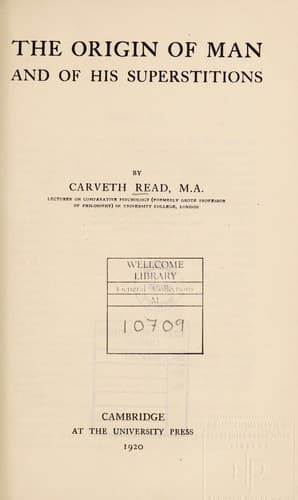
The Origin of Man and of His SuperstitionsRead, Carveth
Philosophy
The Origin of Man and of His Superstitions
Read, Carveth
Animism; Human beings -- Origin; Magic; Superstition; Totemism
(iii) The persevering wizard is often aided by coincidences. An
Australian squatter at Morton’s Plains, after a drought, promised
a native rain-maker half a bullock, a bag of flour and some tea,
if he would fill his new tank for him before the morrow night. The
rain-maker set his rites and spells to work, filled the tank and got
the reward.[505] Whilst Messrs. Spencer and Gillen were with the
Urabunna tribe, “the leading rain-maker performed a ceremony and within
two days there was a downpour—possibly connected with the fact that
it was the usual time for rain to fall in that part of the country.”
The reputation of the rain-maker was firmly established, and, no
doubt, his self-confidence. The Australian wizard already mentioned,
who thought that his Magic had entered his own head, claimed to have
driven away a comet by means of his magic stones. Certainly the comet
disappeared, and what other cause could any one point out? “At one time
the gusts were very unpleasant and one of the men told a wind-man to
make it stop. Accordingly he shouted out to the wind, and in a minute
there was a lull; and no one doubted that this was due to the power of
the wind-man.”[506] Many similar cases might be given.[507] Striking
coincidences are not very rare: there is an illogical prejudice that
they are rare because they excite wonder. Moreover, as I have observed,
so remote a resemblance to the event shamanised or prophesied may be
regarded as a fulfilment, that fulfilment is not uncommon. In the
interpretation of omens, where there is only the alternative of good
or ill success, half the guesses must be right; and by the glozing of
doubtful cases, more than half will seem to be right. And as for the
effect of coincidence, Mr. Basil Thompson says, “Tongans never admit
coincidences”[508]—that is to say, in our sense of the word: for them,
in what we call coincidence, there must be causation; and this seems
to be generally true of the untutored mind. Among the Churaches, the
profession of shaman is generally hereditary; but a man may become a
shaman against his will. It is enough “to make a lucky guess as to
the issue of some event, and people flock to him for advice from all
parts.”[509] How many failures are necessary to discredit one lucky
guess?
Public-domain text, read in full here on John Shaqi.
Reviews
Reviews
No reviews yet
Be the first to share your thoughts on this work.
Elsewhere in the archive
Join the Discussion
Join the discussion
Sign in to leave a comment or review.
Sign InorCreate an account