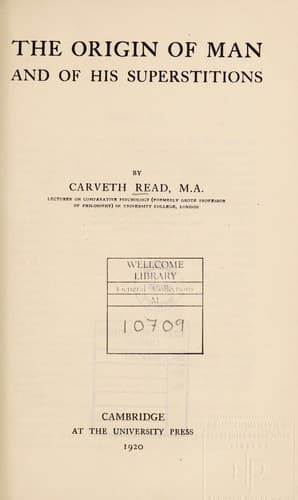
The Origin of Man and of His SuperstitionsRead, Carveth
Philosophy
The Origin of Man and of His Superstitions
Read, Carveth
Animism; Human beings -- Origin; Magic; Superstition; Totemism
These three kinds of evidence in favour of the wizard’s power—natural
causes set in motion by himself, natural causes introduced by his
clients, and sheer favourable coincidences—have so much the air of
perceptual proof, or of an appeal to common sense, that the savage
positivist who is able to resist them must have a more solid judgment
than most of our educated civilised people. Judgment is an innate
individual character, on which education has little effect, except in
the special department of a man’s training. A scientific expert, for
example, may be an excellent judge of evidence in his own pursuit,
and elsewhere quite helpless; for where he is strong it is not a set
of rules but the mass of his special experience that guides him. That
out of the mass of general experience, so disorderly and fragmentary
as it is, some minds should have the power of extracting common sense,
in spite of the misrepresentations of Magic and Animism, is very
remarkable, and very fortunate for the rest of us.
That the three kinds of evidence which serve so well to confirm belief
in wizardry are all of them—as to the connexion between a wizard’s
rites or spells and the event—entirely coincidental, gives some
support to the hypothesis that coincidences are the foundation of the
belief in Magic.
Bearing in mind, then, that a wizard’s practices sometimes include real
causes, and that his shallow knowledge disables him for discriminating
between causation and hocus-pocus; that Magic or Sorcery is generally
believed in by those about him, who seek his aid, or the aid of
others of his class; that both they and he earnestly desire that
his pretensions should be well founded; that he produces striking
subjective effects; that in such cases his artifices are a condition of
his success, and that a good many coincidences, complete or partial,
seem to prove that his art has further extraordinary influence upon men
and nature—it is no wonder that some wizards are deluded along with
their dupes, especially neurotic enthusiasts or men of an imaginative
and histrionic temperament.
To explain the possibility of some men being sincere in witchcraft is
not to palliate the profession, much less the anti-social practices
of witchcraft. For the most part those practices are deceitful. They
are not the invention of savage society; society invents nothing;
only the individual invents. They are the invention and tradition of
wizards, who keep the secret so far as it is to their advantage: of
wizards growing more and more professional, and trading upon the fears
and hopes, the anxiety and credulity of their fellows. The spirit of
superstition is common to the tribe, but its professional exploitation
is the work of those who profit by it.
Public-domain text, read in full here on John Shaqi.
Reviews
Reviews
No reviews yet
Be the first to share your thoughts on this work.
Elsewhere in the archive
Join the Discussion
Join the discussion
Sign in to leave a comment or review.
Sign InorCreate an account