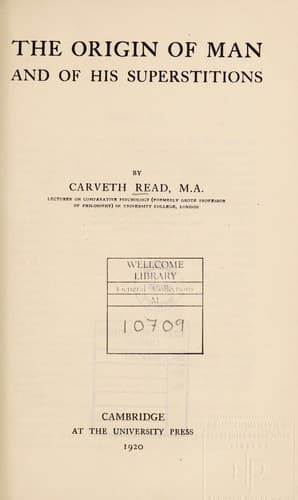
The Origin of Man and of His SuperstitionsRead, Carveth
Philosophy
The Origin of Man and of His Superstitions
Read, Carveth
Animism; Human beings -- Origin; Magic; Superstition; Totemism
This definition is scientifically drawn so as to include what is common
to all Totems and not to include any character that is not universally
connected with them. It is true of the Totems of individuals (or
guardian genii), very common among the Northern Amerinds; as well as
of the Sex-Totems (say Bat for men and Owl for women) which occur in
Australia; and of the Totems of clans found in many parts of the world,
of which the Australian may be supposed most nearly to represent the
original institution. When one speaks of Totems without qualification,
one means these Clan-Totems, being incomparably the most important:
others probably derive from them.
“The Clan-Totem” (to quote the same source) “is reverenced by a body
of men and women who call themselves by the name of the Totem, believe
themselves to be of one blood, descendants of a common ancestor, and
are bound together by common obligations to each other and by a common
faith in the Totem.”[511] This definition is also strict: whereas it
is not uncommon for writers on Totemism to include in their notion
of the Totem other characters which are accidents more or less often
associated with it: as that the clan believes itself descended from the
Totem; though in many cases the clan traces its origin to something
that was neither Totem nor man, or regards the Totem animal as
descended from their own human ancestress, or tells some story of the
transformation of a man into an animal, or of an animal into a man, or
of an ancestor’s friendship with the Totem animal; for the institution
is a copious source of explanatory myths. Again, it may be written that
no member of a clan may kill or injure the Totem, or eat, or utilise
it (if an animal or plant); and this is often, but not always true. If
the Totem is water, or the most important food in the district—dugong,
turtle, coconut, sago—abstention is impossible or intolerably
inconvenient. Hence among the Kaitish a Water clansman when alone may
drink; but if others are with him he may drink only when water is
given him by a man of another Totem. And to eat a little of the Totem
sacramentally, in order to confirm one’s identity with it, may be
allowed or (rather) required. Among the Warramunga the Snake clan may
kill snakes. It may even be the clan’s duty to destroy or drive away
their Totem; as happens with the Mosquito clan of the Kakadus in North
Australia, and with the Reptile clan amongst the Omahas. Similarly, the
clan sometimes, but by no means always, imitate the Totem in character,
in costume, in dances, or bear in tattoo or otherwise its badge to
manifest the community of nature. They may be thought to have special
magical powers to influence its fertility or to control its actions
(actions of game or wind or rain), and may use these powers for the
benefit of the tribe. At death the soul of a clansman may pass into,
or may appear as, the Totem animal. The Totem may be the protector of
Public-domain text, read in full here on John Shaqi.
Reviews
Reviews
No reviews yet
Be the first to share your thoughts on this work.
Elsewhere in the archive
Join the Discussion
Join the discussion
Sign in to leave a comment or review.
Sign InorCreate an account