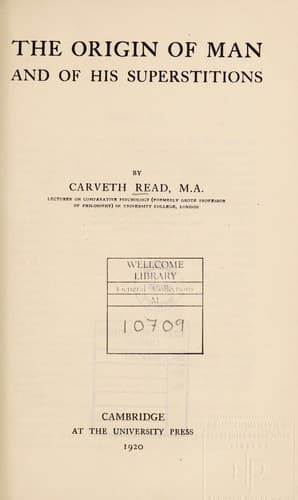
The Origin of Man and of His SuperstitionsRead, Carveth
Philosophy
The Origin of Man and of His Superstitions
Read, Carveth
Animism; Human beings -- Origin; Magic; Superstition; Totemism
It is reported that amongst the Euahlayi tribe occur personal Totems
(or guardians, rare in Australia) called Yunbeai, possessed chiefly
by wizards. A man may eat his hereditary Totem, but not his Yunbeai;
which in this privilege seems to have supplanted the Totem. His spirit
is in the Yunbeai, and its spirit is in him.[532] They have, then, the
same soul; and, although this belief is not strictly Totemism, it is
probably derived from it. A clansman of the Yuin tribe (West Australia)
had as his Totem the Black Duck, which warned him against enemies;
and he related that once, whilst he slept, a Lace-Lizard man sent
his Totem, which went down his throat and almost ate his Black Duck
residing in his breast; so that he nearly died.[533] Were not his Black
Duck and his soul the same?
This hypothesis agrees very well with a belief that one’s body and
soul descend from the same ancestor as the Totem’s; and that at death
one goes to, or becomes, the Totem; and excuses the fiction that the
quickening of a pregnant woman may be caused by the entry into her of
the spirit of some totem-plant or animal.
On the Gold Coast and elsewhere in West Africa, a man has more than
one soul, it may be as many as four; and one of them dwells with some
animal in the bush: thence called his “bush-soul.” Sir James Frazer’s
first hypothesis concerning Totemism was that it may have been derived
from the notion of an external soul which may be deposited in anything
(as thus in an animal in the bush) for safety. He now thinks the
connexion of the “bush-soul” with Totemism uncertain.[534] If there
has been any connexion, may it not be that the “bush-soul” is derived
from Totemism, and that every Totem is a sort of “bush-soul”—that is,
it has a soul which is the same (at least, of the same kind) as the
clansman’s?
§ 7. TOTEMISM AND MAGIC
The identity of a man with his name, as usually assumed by savages,
whether his personal or his totemic name, is not itself a magical
belief, but an inevitable result of mental association at a low level
of intelligence: perhaps earlier than any notions that can properly be
called magical. The name of a man, always thought of along with his
other properties, seems to be as much one of them as a scar on his neck
or any peculiar trait of visage or length of limb. This must be as old
as naming. But such a complication of the name with other marks having
been formed, it becomes the ground of magic beliefs and practices.
To mention the name of a man or spirit insures his presence and
participation in any rite, either acting or suffering; or where writing
is known, his name on a piece of paper is as good as his nail-parings.
The use of the name is not a mere animistic summons (which might be
disobeyed), but an immediate instatement of the given individual. Such
magic may enter into totemic observances.
Public-domain text, read in full here on John Shaqi.
Reviews
Reviews
No reviews yet
Be the first to share your thoughts on this work.
Elsewhere in the archive
Join the Discussion
Join the discussion
Sign in to leave a comment or review.
Sign InorCreate an account