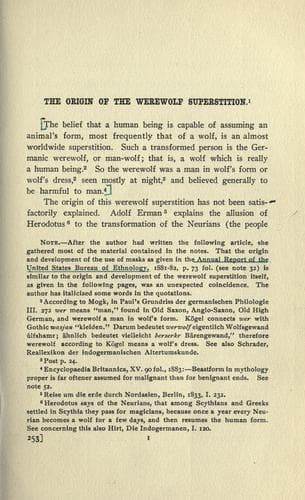
The Origin of the Werewolf SuperstitionStewart, Caroline Taylor
History
The Origin of the Werewolf Superstition
Stewart, Caroline Taylor
Werewolves
a). It was used as a shield or protection for the face, for
defense against physical violence, human or otherwise. It
was therefore first used merely as a mechanical resistance
to the opposing force; then secondly, still in the lowest
grade of culture, it was used to inspire terror, to gain a
moral influence over the opposing agent by hideousness or by
symbolizing superhuman agencies. Now individual variations
arose—devices for example derived or conventionalized from
some predatory, shrewd or mysterious animal.
b). With growth of culture came growth of supernaturalism, and
the mask came to be used in religious performances, as a part
of the religious paraphernalia, like the shirts or girdles of
the shamans. Ethn. Rep. 1896-97, I. 395:—“When worn in any
ceremonial, ... the wearer is believed to become mysteriously
and unconsciously imbued with the spirit of the being which his
mask represents.”
c). Finally the element of humor enters in, and the mask is
used for public amusements and games; by secret societies; as
protection against recognition on festive occasions, etc., like
the animal skins worn in dances.
(2) To secure clothing in cold climes by trapping or decoying animals,
as in (1) above.
(3) The imitation when decoying, of the motions of animals led to
dancing, and in the dances and various ceremonies the faces and bodies
of the participants were painted in imitation of the colors of birds
and animals, the motions of animals imitated and animal disguises
used.[58]
[58] Notes 32, 34, 33, ante p. 11.
(4) Scouts disguised themselves as animals when out foraging, as well
as for warfare,[59][60] therefore for booty, and self-defense. Either
they wore the entire skin, or probably later just a part of it as a
fetich, like the left hind foot of a rabbit, worn as a charm by many of
our colored people to-day.[61]
[59] See p. 13.
Public-domain text, read in full here on John Shaqi.
Reviews
Reviews
No reviews yet
Be the first to share your thoughts on this work.
Join the Discussion
Join the discussion
Sign in to leave a comment or review.
Sign InorCreate an account