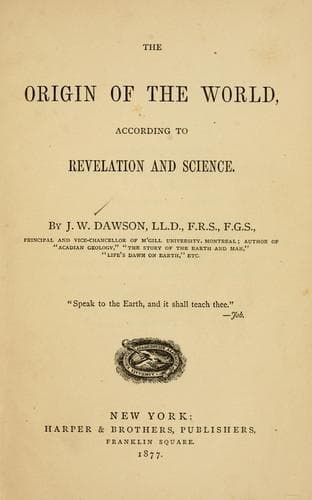
The Origin of the World According to Revelation and ScienceDawson, John William, Sir
Religion
The Origin of the World According to Revelation and Science
Dawson, John William, Sir
Bible and science; Religion and science
Max Mueller, in his lectures on the Science of Religion, rejects the
ordinary division into natural and revealed, and adopts a threefold
grouping, corresponding to the great division of languages into
Turanian, Aryan, and Semitic. With some modification and explanation,
this classification will serve well our present purpose. As to natural
and revealed religions, if we regard our own as revealed, we must
admit an element of revelation in all others as well. According to the
Hebrew Scriptures revelation began in Eden, and was continued more or
less in all successive ages up to the apostolic times. Consequently
the earlier revelations of the antediluvian and postdiluvian times
must have been the common property of all races, and must have been
associated with whatever elements of natural religion they had. When,
therefore, we call our religion distinctively a revealed one, we must
admit that traces of the same revelation may be found in all others.
On the other hand, when we characterize our religion as Hebrew or
Semitic, we must bear in mind that in its earlier stages it was not so
limited; but that, if as old as it professes to be, it must include a
substratum common to it with the old religions of the Turanians and
Aryans. Neglect of these very simple considerations often leads to
great confusion in the minds both of Christians and unbelievers, as to
the relation of Christianity to heathenism, and especially to the
older and more primitive forms of heathenism.
The Turanian stock, of which the Mongolian peoples of Northern Asia
may be taken as the type, includes also the American races, and the
oldest historical populations of Western Asia and of Europe; and they
are the peoples who, in their physical features and their art
tendencies, most nearly resemble the prehistoric men of the caves and
gravels. They largely consist of the populations which the Bible
affiliates with Ham. They are remarkable for their permanent and
stationary forms of civilization or barbarism, and for the languages
least developed in grammatical structure. These people had and still
have traditions of the creation and early history of man similar to
those in the earlier Biblical books; but the connection of their
religions with that of the Bible breaks off from the time of Abraham;
and the earlier portions of revelation which they possessed became
disintegrated into a polytheism which takes very largely the form of
animism, or of attributing some special spiritual indwelling to all
natural objects, and also that of worship of ancestors and heroes. The
portion of primitive theological belief to which they have clung most
persistently is the doctrine of the immortality of the soul, which in
all their religious beliefs occupies a prominent place, and has always
been connected with special attention to rites of sepulture and
monuments to the dead. Their version of the revelation of creation
appears most distinctly in the sacred book of the Quiches of Central
Public-domain text, read in full here on John Shaqi.
Reviews
Reviews
No reviews yet
Be the first to share your thoughts on this work.
Join the Discussion
Join the discussion
Sign in to leave a comment or review.
Sign InorCreate an account