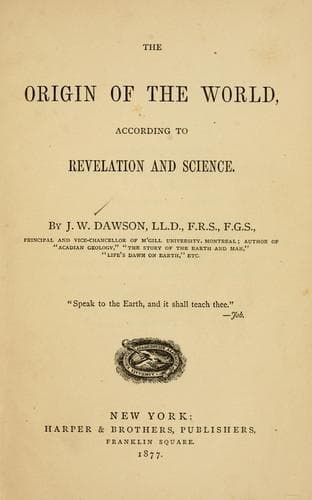
The Origin of the World According to Revelation and ScienceDawson, John William, Sir
Religion
The Origin of the World According to Revelation and Science
Dawson, John William, Sir
Bible and science; Religion and science
I have hitherto in this part of the discussion avoided detailed
reference to what may be regarded as the "prophetic day" view of the
narrative of creation. This may be shortly stated as follows: In the
prophetical parts of Scripture the prophet sees in vision, as in a
picture or acted scene, the events that are to come to pass, and in
consequence represents years or longer periods by days of vision. Now
the revelation of the pre-Adamite past is in its nature akin to that
of the unknown future; and Moses may have seen these wondrous events
in vision--in visions of successive days--under the guise of which he
presents geological time. Some things in the form of the narrative
favor this view, and it certainly affords the most clearly
intelligible theory as to the mode in which such a revelation may have
been made to man. It is advocated by Kurtz, by the author of an
excellent little work, the "Harmony of the Mosaic and Geological
Records," by Hugh Miller, and more recently by Tayler Lewis. To these
writers I must refer for its more full illustration, and for the grand
pictorial view which it gives of the vision of the creative week.
In reviewing the somewhat lengthy train of reasoning into which the
term "day" has led us, it appears that from internal evidence alone it
can be rendered probable that the day of creation is neither the
natural nor the civil day. It also appears that the objections urged
against the doctrine of day-periods are of no weight when properly
scrutinized, and that it harmonizes with the progressive nature of the
work, the evidence of geology, and the cosmological notions of ancient
nations. I do not suppose that this position has been incontrovertibly
established; but I believe that every serious difficulty has been
removed from its acceptance; and with this, for the present, I remain
satisfied. Every step of our subsequent progress will afford new
criteria of its truth or fallacy.
One further question of some interest is--What, according to the
theory of long creative days and the testimony of geology, would be
the length and precise cosmical nature of these days? With regard to
the first part of the question, we do not know the actual value of our
geological ages in time; but it is probable that each great creative
aeon may have extended through millions of years. As to the nature of
the days, this may have been determined by direct volitions of the
Creator, or indirectly by some of those great astronomical cycles
which arise from the varying eccentricity of the earth's orbit, or the
diminution of the velocity of its rotation, or by its gradual cooling.
Public-domain text, read in full here on John Shaqi.
Reviews
Reviews
No reviews yet
Be the first to share your thoughts on this work.
Elsewhere in the archive
Join the Discussion
Join the discussion
Sign in to leave a comment or review.
Sign InorCreate an account