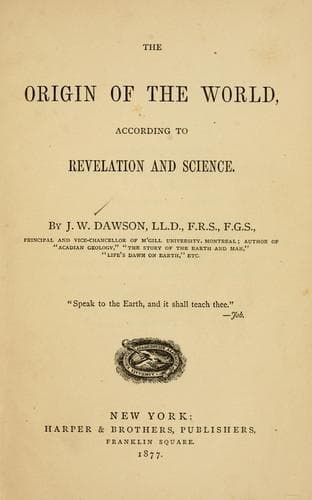
The Origin of the World According to Revelation and ScienceDawson, John William, Sir
Religion
The Origin of the World According to Revelation and Science
Dawson, John William, Sir
Bible and science; Religion and science
With reference to these points, science has as yet little information
to give. Sir William Thomson has, indeed, indicated for the time since
the earth's crust first began to form a period of between one and two
hundred millions of years; but Professor Guthrie Tait, on the other
hand, argues that ten or fifteen millions of years are probably
sufficient,[65] and Lockyer has suggested an hypothesis of successive
rekindlings of the solar heat which might give a more protracted time
than that of Thomson. Some of the hypotheses of derivation current,
but which are based rather on philosophical speculation than on
scientific fact, would also require a longer time than that allowed by
Thomson; and it is to be regretted that some geologists, by giving
credence to such hypotheses of derivation, and by loose reasoning on
the time required for the denudation and deposition of rocks, have
been induced to commit themselves to very extravagant estimates as to
geological time. On the whole, it is evident that only the most vague
guesses can at present be based on the facts in our possession, though
the whole time required has unquestionably been very great, the
deposition of the series of stratified rocks probably requiring at
least the greater part of the minimum time allowed by Thomson.[66]
As to the cosmical nature of the periods, while some geologists appear
to regard the whole of geological time as a continuous evolution
without any breaks, it is evidently more in accordance with facts to
hold that there have been cycles of repose and activity succeeding
each other, and that these have been of different grades. In the
succession of deposits it is plain that periods of depression and
upheaval common to all the continental masses have succeeded each
other at somewhat regular intervals, and that within these periods
there have been alternations of colder and warmer climates. These,
however, are not equal to the creative days of our record, for they
are greatly more numerous. They are but the vastly protracted hours of
these almost endless days. Beyond and above these there is another
grade of geological period, marked not by mere gradual elevation and
depression of the continental areas, but by vast crumplings of the
earth's crust and enormous changes of level. Such a great movement
unquestionably closed the Eozoic period of geology. Another of less
magnitude occurred in what is termed the Permian age at the end of the
Palaeozoic. A third terminated the Mesozoic age, and introduced the
Tertiary or Kainozoic. Perhaps we should reckon the glacial age,
though characterized by far less physical change than the others, as a
fourth. The possible physical causes which have been suggested for
such greater disturbances are the collapses of the crust in equatorial
regions, which may be supposed to have resulted at long intervals of
time, from the gradual retardation of the earth's rotation caused by
the tides, or the similar collapses and other changes due to the
Public-domain text, read in full here on John Shaqi.
Reviews
Reviews
No reviews yet
Be the first to share your thoughts on this work.
Elsewhere in the archive
Join the Discussion
Join the discussion
Sign in to leave a comment or review.
Sign InorCreate an account