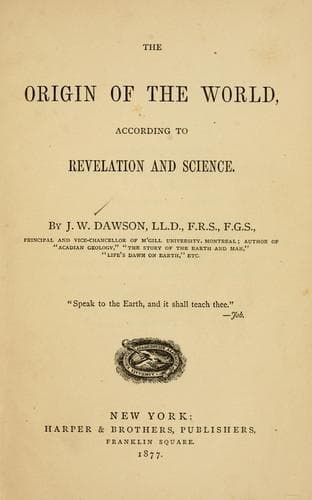
The Origin of the World According to Revelation and ScienceDawson, John William, Sir
Religion
The Origin of the World According to Revelation and Science
Dawson, John William, Sir
Bible and science; Religion and science
The regular and constant constituents of the atmosphere are the
elements oxygen and nitrogen, which, at the temperature and pressure
existing on the surface of our globe, are permanently aeriform or
gaseous. Beside these gases, the air always contains a quantity of the
vapor of water in a perfectly aeriform and transparent condition. This
vapor is not, however, permanently gaseous. At all temperatures below
212 degrees it tends to the liquid state; and its elastic force, which
preserves its particles in the separated state of vapor, increases or
diminishes at a more rapid rate than the increase or diminution of
temperature. Hence the quantity of vapor that can be suspended in
clear air depends on the temperature of the air itself. As the
temperature of the air rises, its power of sustaining vapor increases
more rapidly than its temperature; and as the temperature of the air
falls, the elastic force of its contained vapor diminishes in a
greater ratio, until it can exist as an invisible vapor no longer, but
becomes condensed into minute bubbles or globules, forming cloud,
mist, or rain. Two other circumstances operate along with these
properties of air and vapor. The heat radiated from the earth's
surface causes the lower strata of air to be, in ordinary
circumstances, warmer than the higher; and, on the other hand, warm
air, being lighter than that which is colder, the warm layer of air at
the surface continually tends to rise through and above the colder
currents immediately over it. Let us consider the operation of the
causes thus roughly sketched in a column of calm air. The lower
portion becomes warmed, and if in contact with water takes up a
quantity of its vapor proportioned to the temperature, or in ordinary
circumstances somewhat less than this proportion. It then tends to
ascend, and as it rises and becomes mixed with colder air it gradually
loses its power of sustaining moisture, and at a height proportioned
to the diminution of temperature and the quantity of vapor originally
contained in the air, it begins to part with water, which becomes
condensed in the form of mist or cloud; and the surface at which this
precipitation takes place is often still more distinctly marked when
two masses or layers of air at different temperatures become
intermixed; in which case, on the principle already stated, the mean
temperature produced is unable to sustain the vapor proper to the two
extremes, and moisture is precipitated. It thus happens that layers
of cloud accumulate in the atmosphere, while between them and the
surface there is a stratum of clear air. Fogs and mists are in the
present state of nature exceptional appearances, depending generally
on local causes, and showing what the world might be but for that
balancing of temperature and the elastic force of vapor which
constitutes the atmospheric firmament.[68]
Public-domain text, read in full here on John Shaqi.
Reviews
Reviews
No reviews yet
Be the first to share your thoughts on this work.
Elsewhere in the archive
Join the Discussion
Join the discussion
Sign in to leave a comment or review.
Sign InorCreate an account