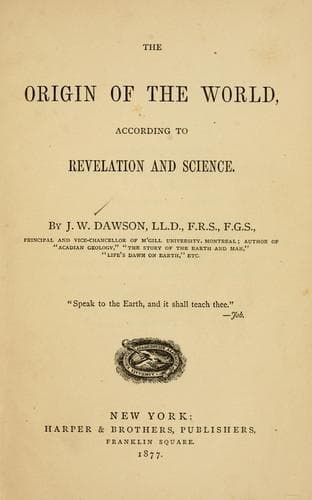
The Origin of the World According to Revelation and ScienceDawson, John William, Sir
Religion
The Origin of the World According to Revelation and Science
Dawson, John William, Sir
Bible and science; Religion and science
The quantity of water thus suspended over the earth is enormous. "When
we see a cloud resolve itself into rain, and pour out thousands of
gallons of water, we can not comprehend how it can float in the
atmosphere."[69] The explanation is--1st, the extreme levity of the
minute globules, which causes them to fall very slowly; 2d, they are
supported by currents of air, especially by the ascending currents
developed both in still air and in storms; 3dly, clouds are often
dissolving on one side and forming on another. A cloud gradually
descending may be dissolving away by evaporation at the base as fast
as new matter is being added above. On the other hand, an ascending
warm current of air may be constantly depositing moisture at the base
of the cloud, and this may be evaporating under the solar rays above.
In this case a cloud is "merely the visible form of an aerial space,
in which certain processes are at the moment in equilibrium, and all
the particles in a state of upward movement."[70] But so soon as
condensation markedly exceeds evaporation, rain falls, and the
atmosphere discharges its vast load of water--how vast we may gather
from the fact that the waters of all the rivers are but a part of the
overflowings of the great atmospheric reservoir. "God binds up the
waters in his thick cloud, and the cloud is not rent under them." It
is thus that the terrestrial waters are divided into those above and
those below that expanse of clear air in which we live and move,
exempt from the dense, dark mists of the earth's earlier state, yet
enjoying the benefits of the cloudy curtain that veils the burning
sun, and of the cloudy reservoirs that drop down rain to nourish every
green thing.
Public-domain text, read in full here on John Shaqi.
Reviews
Reviews
No reviews yet
Be the first to share your thoughts on this work.
Elsewhere in the archive
Join the Discussion
Join the discussion
Sign in to leave a comment or review.
Sign InorCreate an account