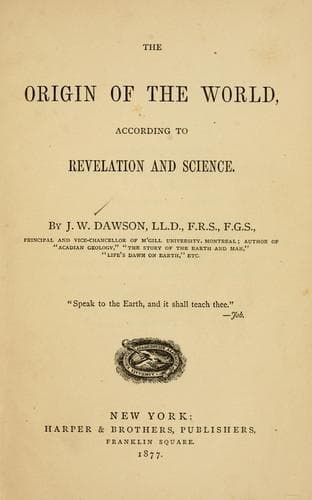
The Origin of the World According to Revelation and ScienceDawson, John William, Sir
Religion
The Origin of the World According to Revelation and Science
Dawson, John William, Sir
Bible and science; Religion and science
The empire of Assyria went down in blood, and its palaces were
destroyed with fire, but the imperishable clay tablets which had
formed the treasure of their libraries remained, more or less broken
it is true, among the ruins. Exhumed by Layard and Smith, they are now
among the collections of the British Museum, and their decipherment is
throwing a new and strange light on the cosmogony and religions of the
early East. Though the date of the writing of these tablets is
comparatively modern, being about the time of the later kings of
Judah, the original records from which they were transcribed profess
to have been very ancient--some of them about 1600 years before the
time of Assurbanipal, so that they go back to a time anterior to that
of the early Hebrew patriarchs. Their genuineness has been endorsed,
in one case, by the discovery by Mr. Loftus, in the city of Senkereh,
of an apparent original, bearing date about 1600 years before Christ,
and other inscriptions of equal or greater antiquity have been found
in the ruins of Ur, on the Euphrates. Nor does there seem any reason
to doubt that the scribes of Assurbanipal faithfully transcribed the
oldest records extant in their time. Their care and diligence are also
shown by the fact that where different versions of these records
existed in different cities, they have made copies of these variant
manuscripts, instead of attempting to reduce them to one text. The
subjects treated of in the Nineveh tablets are very various, but those
that concern our present purpose are the documents relating to the
creation, the fall of man, and the deluge, of which considerable
portions have been recovered, and have been translated by Mr. Smith.
These documents carry us back to a time when the Turanian religions
had not yet been separated from the Semitic. The early Chaldeans,
termed Cushites in the Bible, and who under Nimrod seem to have
established the first empire in that region, are now known to have
been Turanian; and among them apparently arose at a very early period
a literature and a mythology. The Chaldeans were politically
subjugated by the Semitic Assyrians, but they retained their religious
predominance; and until a comparatively late period existed as a
learned and priestly caste. To these primitive _Chasdim_ were
undoubtedly due the creation legends collected by the scribes of
Assurbanipal. They were obtained in the old Chaldean cities, in the
temples under the guardianship of Chaldean priests; and their date
carries them back to a time anterior to the Assyrian conquest, and in
which Chaldean kings still reigned. Here, then, we have an important
connecting link between the cosmogonies of the Turanian and Semitic
races; and leaving out of sight for the present the legends of the
deluge and other matters allied to it, we may inquire as to the nature
and contents of the Assyrian and Chaldean record of creation.
Public-domain text, read in full here on John Shaqi.
Reviews
Reviews
No reviews yet
Be the first to share your thoughts on this work.
Join the Discussion
Join the discussion
Sign in to leave a comment or review.
Sign InorCreate an account