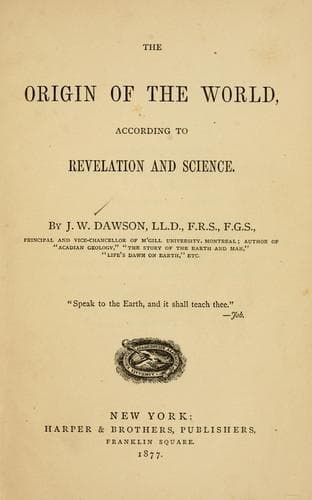
The Origin of the World According to Revelation and ScienceDawson, John William, Sir
Religion
The Origin of the World According to Revelation and Science
Dawson, John William, Sir
Bible and science; Religion and science
1. In accordance with the views now entertained by the best
lexicographers, the word translated in our version "creeping things"
has been rendered "prolific or swarming creatures." The Hebrew is
_Sheretz_, a noun derived from the verb used in this verse to denote
bringing forth abundantly. It is loosely translated in the Septuagint
_Erpeta_, reptiles; and this view our English translators appear to
have adopted, without, perhaps, any very clear notions of the
creatures intended. The manner in which it is used in other passages
places its true meaning beyond doubt. I select as illustrations of
the most apposite character those verses in Leviticus in which clean
and unclean animals are specified, and in which we have a right to
expect the most precise zoological nomenclature that the Hebrew can
afford. In Leviticus xi., 20-23, _insects_ are defined to be _flying
sheretzim_, and in verse 29, etc., under the designation "_sheretzim
of the land_," we have animals named in our version the weasel, mouse,
tortoise, ferret, chameleon, lizard, snail, and mole. The first of
these animals is believed to have been a burrowing creature, perhaps a
mole; the second, from the meaning of its name, "ravager of fields,"
is thought to have been a mouse. Some doubt, however, attends both of
these identifications, but it appears certain that the remaining six
species are small reptiles, principally lizards. We learn, therefore,
that the smaller reptiles, and _perhaps_ also a few small mammals, are
_sheretzim_. In verses 41 and 42 we are introduced to other tribes.
"And every _sheretz_ that swarmeth on the earth shall be an
abomination unto you; it shall not be eaten; whatsoever goeth upon the
belly (serpents, worms, snails, etc.), and whatsoever hath more feet
(than four) (insects, arachnidans, myriapods)." In verses 9 and 10 of
the same chapter we have an enumeration of the _sheretzim_ of the
waters: "Whatsoever hath fins and scales in the waters, in the seas
and in the rivers, them shall ye eat. And all that have not fins and
scales in the seas and the rivers, of all that swarm in the waters
(all the _sheretzim_ of the waters), they shall be an abomination unto
you." Here the general term _sheretz_ includes all the fishes and the
invertebrate animals of the waters. From the whole of the above
passages we learn that this is a general term for all the invertebrate
animals and the two lower classes of vertebrates, or, in other words,
for the whole animal kingdom except the mammalia and birds. To all
these creatures the name is particularly appropriate, all of them
being oviparous or ovoviviparous, and consequently producing great
numbers of young and multiplying very rapidly. The only other
creatures which can be included under the term are the two doubtful
species of small mammals already mentioned. Nothing can be more fair
and obvious than this explanation of the term, based both on etymology
and on the precise nomenclature of the ceremonial law. We conclude,
Public-domain text, read in full here on John Shaqi.
Reviews
Reviews
No reviews yet
Be the first to share your thoughts on this work.
Elsewhere in the archive
Join the Discussion
Join the discussion
Sign in to leave a comment or review.
Sign InorCreate an account