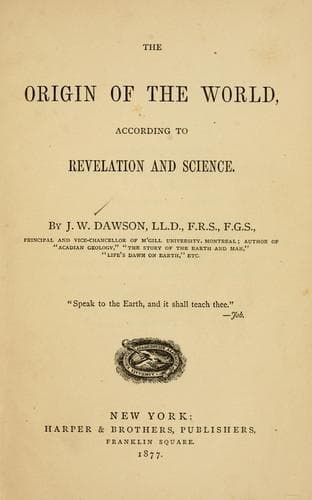
The Origin of the World According to Revelation and ScienceDawson, John William, Sir
Religion
The Origin of the World According to Revelation and Science
Dawson, John William, Sir
Bible and science; Religion and science
therefore, that the prolific animals of the fifth day's creation
belonged to the three Cuvierian sub-kingdoms of the Radiata,
Articulata, and Mollusca, and to the classes of Fish and Reptiles
among the vertebrata.
2. One peculiar group of _sheretzim_ is especially distinguished by
name--the _tanninim_, or "great whales" of our version. It would be
amusing, had we time, to notice the variety of conjectures to which
this word has given rise, and the perplexities of commentators in
reference to it. In our version and the Septuagint it is usually
rendered dragon; but in this place the seventy have thought proper to
put _Ketos_ (whale), and our translators have followed them.
Subsequent translators and commentators have laid under contribution
all sorts of marine monsters, including the sea-serpent, in their
endeavors to attach a precise meaning to the word; while others have
been content to admit that it may signify any kind or all kinds of
large aquatic animals. The greater part of the difficulty appears to
have arisen from confounding two distinct words, _tannin_ and _tan_,
both names of animals; and the confusion has been increased by the
circumstance that in two places the words have been interchanged,
probably by errors of transcribers. _Tan_ occurs in twelve places, and
from these we can gather that it inhabits ruined cities, deserts, and
places to which ostriches resort, that it suckles its young, is of
predaceous and shy habits, utters a wailing cry, and is not of large
size, nor formidable to man. The most probable conjecture as to the
animal intended is that of Gesenius, who supposes it to be the jackal.
The other word (_tannin_), which is that used in the text, is applied
as an emblem of Egypt and its kings, and also of the conquering kings
of Babylon. It is spoken of as furious when enraged, and formidable to
man, and is said to be an inhabitant of rivers and of the sea, but
more especially of the Nile. In short, it is the crocodile of the
Nile. We can easily understand the perplexity of those writers who
suppose these two words to be identical, and endeavor to combine all
the characters above mentioned in one animal or tribe of animals. As a
farther illustration of the marked difference in the meanings of the
two words, we may compare the 34th and 37th verses of the fifty-first
chapter of Jeremiah. In the first of these verses the King of Babylon
is represented as a "dragon" (_tannin_), which had swallowed up
Israel. In the second it is predicted that Babylon itself shall become
heaps, a dwelling-place for "dragons" (_tanim_). There can be no doubt
that the animals intended here are quite different. The devouring
_tannin_ is a huge predaceous river reptile, a fit emblem of the
Babylonian monarch; the _tan_ is the jackal that will soon howl in his
ruined palaces. It is interesting to know that philologists trace a
connection between _tannin_ and the Greek _teino_, Latin _tendo_, and
Public-domain text, read in full here on John Shaqi.
Reviews
Reviews
No reviews yet
Be the first to share your thoughts on this work.
Elsewhere in the archive
Join the Discussion
Join the discussion
Sign in to leave a comment or review.
Sign InorCreate an account