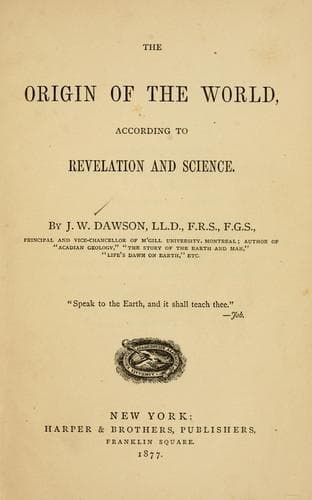
The Origin of the World According to Revelation and ScienceDawson, John William, Sir
Religion
The Origin of the World According to Revelation and Science
Dawson, John William, Sir
Bible and science; Religion and science
similar words, signifying to stretch or extend, in the Sanscrit,
Gothic, and other languages, leading to the inference that the Hebrew
word primarily denotes a lengthened or extended creature, which
corresponds well with its application to the crocodile. Taking all the
above facts in connection, we are quite safe in concluding that the
creatures referred to by the word under consideration are literally
large reptilian animals; and, from the special mention made of them,
we may infer that, in their day, they were the lords of creation.[94]
3. In verse 21 the remainder of the _sheretzim_, besides the larger
reptiles, are included in the general expression, "Living creature
that moveth." The term "living creature" is, literally, "creature
having the breath of life;" the power of respiration being apparently
in Hebrew the distinctive character of the animal. The word moveth
(_ramash_), in its more general sense, expresses the power of
voluntary motion, as exhibited in animals in general. In a few places,
however, it has a more precise meaning, as in 1 Kings iv., 33, where
the vertebrated animals are included in the four classes of "beasts,
fowl, _creeping things_ (or reptiles, _remes_), and fishes." In the
present connection it probably has its most general sense; unless,
indeed, the apparent repetition in this verse relates to the
amphibious or semi-terrestrial creatures associated with the great
reptiles; and, in that case, the humbler reptilian animals alone may
be meant.
4. We may again note that the introduction of animal life is marked by
the use of the word "create," for the first time since the general
creation of the heavens and the earth. We may also note that the
animal, as well as the plant, was created "after its kind," or
"species by species." The animals are grouped under three great
classes--the Remes, the Tanninim, and the Birds; but, lest any
misconception should arise as to the relations of species to these
groups, we are expressly informed that the species is here the true
unit of the creative work. It is worth while, therefore, to note that
this most ancient authority on this much controverted topic connects
species on the one hand with the creative fiat, and on the other with
the power of continuous reproduction.
5. In addition to the great mass of _sheretzim_, so accurately
characterized by Milton as
"----Reptile with spawn abundant,"
the creation of the fifth day included a higher tribe of oviparous
animals--the birds, the fowl or winged creature of the text. Birds
alone, we think, must be meant here, as we have already seen that
insects are included under the general term _sheretzim_.
6. It is farther to be observed that _the waters_ give origin to the
first animals--an interesting point when we consider the contrast here
with the creation of plants and of the higher animals, both of which
proceed from the earth.
Public-domain text, read in full here on John Shaqi.
Reviews
Reviews
No reviews yet
Be the first to share your thoughts on this work.
Elsewhere in the archive
Join the Discussion
Join the discussion
Sign in to leave a comment or review.
Sign InorCreate an account