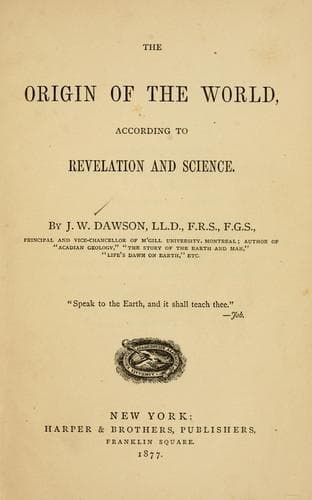
The Origin of the World According to Revelation and ScienceDawson, John William, Sir
Religion
The Origin of the World According to Revelation and Science
Dawson, John William, Sir
Bible and science; Religion and science
The creation of man is prefaced by expressions implying deliberation
and care. It is not said, "Let the earth bring forth" man, but let us
form or fashion man. This marks the relative importance of the human
species, and the heavenly origin of its nobler immaterial part. Man is
also said to have been "created," implying that in his constitution
there was something new and not included in previous parts of the
work, even in its material. Man was created, as the Hebrew literally
reads, the shadow and similitude of God--the greatest of the visible
manifestations of Deity in the lower world--the reflected image of his
Maker, and, under the Supreme Lawgiver, the delegated ruler of the
earth. Now for the first time was the earth tenanted by a being
capable of comprehending the purposes and plans of Jehovah, of
regarding his works with intelligent admiration, and of shadowing
forth the excellences of his moral nature. For countless ages the
earth had been inhabited by creatures wonderful in their structures
and instincts, and mutely testifying, as their buried remains still
do, to the Creator's glory; but limited within a narrow range of
animal propensities, and having no power of raising a thought or
aspiration toward the Being who made them. Now, however, man enters on
the scene, and the sons of God, who had shouted for joy when the first
land emerged from the bosom of the deep, saw the wondrous spectacle of
a spiritual nature analogous to their own, united to a corporeal frame
constructed on the same general type with the higher of those
irrational creatures whose presence on earth they had so long
witnessed.
Man was to rule over the fish of the sea, the birds of the air, and
the _bhemah_ or herbivorous animals. The carnivorous creatures are not
mentioned, and possibly were not included in man's dominion. We shall
find an explanation of this farther on. The nature of man's dominion
we are left to infer. In his state of innocence it must have been a
mild and gentle sway, interfering in no respect wilts the free
exercise of the powers of enjoyment bestowed on animals by the
Creator, a rule akin to that which a merciful man exercises over a
domesticated animal, and which some animals are capable of repaying
with a warm and devoted affection. Now, however, man's rule has become
a tyranny. "The whole creation groans" because of it. He desolates the
face of nature wherever he appears, unsettling the nice balance of
natural agencies, and introducing remediless confusion and suffering
among the lower creatures, even when in the might of his boasted
civilization he professes to renovate and improve the face of nature.
He retains enough of the image of his Maker to enable him to a great
extent to assert his dominion, and to aspire after a restoration of
his original paradise, but he has lost so much that the power which he
retains is necessarily abused to selfish ends.
Public-domain text, read in full here on John Shaqi.
Reviews
Reviews
No reviews yet
Be the first to share your thoughts on this work.
Elsewhere in the archive
Join the Discussion
Join the discussion
Sign in to leave a comment or review.
Sign InorCreate an account