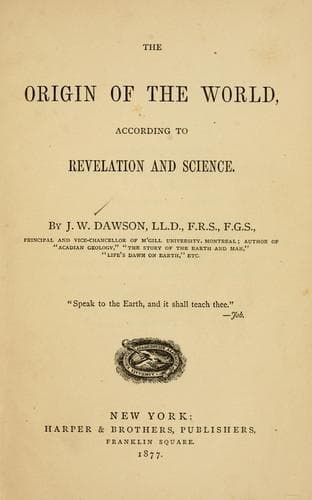
The Origin of the World According to Revelation and ScienceDawson, John William, Sir
Religion
The Origin of the World According to Revelation and Science
Dawson, John William, Sir
Bible and science; Religion and science
Man, like the other creatures, was destined to be fruitful and
multiply and replenish the earth. We are also informed in chapter
second that he was placed in a "garden," a chosen spot in the alluvial
plains of Western Asia, belonging to the later geological formations,
and thus prepared by the whole series of prior geological changes,
replenished with all things useful to him, and containing nothing
hurtful, at least in so far as the animal creation was concerned.
These facts, taken in connection, lead to grave questions. How is the
happy and innocent state of man consistent with the contemporaneous
existence of carnivorous and predaceous animals, which, as both
Scripture and geology state, were created in abundance in the sixth
day? How, when confined to a limited region, could he increase and
multiply and replenish the earth? These questions, which have caused
no little perplexity, are easily solved when brought into the light of
our modern knowledge of nature. 1. Every large region of the earth is
inhabited by a group of animals differing in the proportions of
identical species, and in the presence of distinct species, from the
groups inhabiting other districts. There is also sufficient reason to
conclude that all animals and plants have spread from certain local
centres of creation, in which certain groups of species have been
produced and allowed to extend themselves, until they met and became
intermingled with species extending from other centres. Now the
district of Asia, in the vicinity of the Euphrates and Tigris, to
which the Scripture assigns the origin of the human race, is the
centre to which we can with the greatest probability trace several of
the species of animals and plants most useful to man, and it lies near
the confines of warmer and colder regions of distribution in the Old
World, and also near the boundary of the Asiatic and European regions.
At the period under consideration it may have been peopled with a
group of animals specially suited to association with the progenitors
of mankind. 2. To remove all zoological difficulties from the position
of primeval man in his state of innocence, we have but to suppose, in
accordance with all the probabilities of the case, that man was
created along with a group of creatures adapted to contribute to his
happiness, and having no tendency to injure or annoy; and that it is
the formation of these creatures--the group of his own centre of
creation--that is especially noticed in Genesis ii., 19, _et seq._,
where God is represented as forming them out of the ground and
exhibiting them to Adam; a passage otherwise superfluous, and indeed
tending to confuse the meaning of the document. 3. The difficulty
attending the early extension of the human race is at once obviated by
the geological doctrine of the extinction of species. We know that in
past geological periods large and important groups of species have
become extinct, and have been replaced by new groups extending from
Public-domain text, read in full here on John Shaqi.
Reviews
Reviews
No reviews yet
Be the first to share your thoughts on this work.
Elsewhere in the archive
Join the Discussion
Join the discussion
Sign in to leave a comment or review.
Sign InorCreate an account