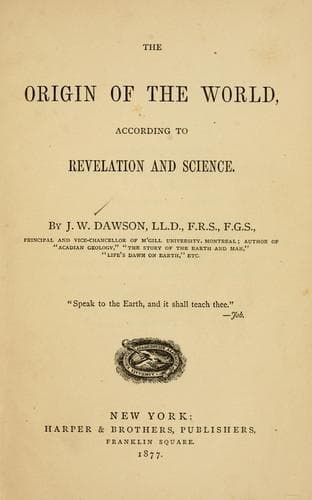
The Origin of the World According to Revelation and ScienceDawson, John William, Sir
Religion
The Origin of the World According to Revelation and Science
Dawson, John William, Sir
Bible and science; Religion and science
new centres; and we know that this process has removed, in early
geological periods, many creatures that would have been highly
injurious to human interests had they remained. Now the group of
species created with man being the latest introduced, we may infer, on
geological grounds, that it would have extended itself within the
spheres of older zoological and botanical districts, and would have
replaced their species, which, in the ordinary operation of natural
laws, may have been verging toward extinction. Thus not only man, but
the Eden in which he dwelt, with all its animals and plants, would
have gradually encroached on the surrounding wilderness, until man's
happy and peaceful reign had replaced that of the ferocious beasts
that preceded him in dominion, and had extended at least over all the
temperate region of the earth. 4. The cursing of the ground for man's
sake, on his fall from innocence, would thus consist in the
permission given to the predaceous animals and the thorns and the
briers of other centres of creation to invade his Eden; or, in his own
expulsion, to contend with the animals and plants which were intended
to have given way and become extinct before him. Thus the fall of man
would produce an arrestment in the progress of the earth in that last
great revolution which would have converted it into an Eden; and the
anomalies of its present state consist, according to Scripture, in a
mixture of the conditions of the tertiary with those of the human
period. 5. Though there is good ground for believing that man was to
have been exempted from the general law of mortality, we can not infer
that any such exemption would have been enjoyed by his companion
animals; we only know that he himself would have been free from all
annoyance and injury and decay from external causes. We may also
conclude that, while Eden was sufficient for his habitation, the
remainder of the earth would continue, just as in the earlier tertiary
periods, under the dominion of the predaceous mammals, reptiles, and
birds. 6. The above views enable us on the one hand to avoid the
difficulties that attend the admission of predaceous animals into
Eden, and on the other the still more formidable difficulties that
attend the attempt to exclude them altogether from the Adamic world.
They also illustrate the geological fact that many animals,
contemporaneous with man, extend far back into the Tertiary period.
These are creatures not belonging to the Edenic centre of creation,
but introduced in an earlier part of the sixth day, and now permitted
to exist along with man in his fallen state. I have stated these
supposed conditions of the Adamic creation briefly, and with as little
illustration as possible, that they may connectedly strike the mind of
the reader. Each of these statements is in harmony with the
Scriptural narrative on the one hand, and with geology on the other;
and, taken together, they afford an intelligible history of the
introduction of man.
Public-domain text, read in full here on John Shaqi.
Reviews
Reviews
No reviews yet
Be the first to share your thoughts on this work.
Elsewhere in the archive
Join the Discussion
Join the discussion
Sign in to leave a comment or review.
Sign InorCreate an account