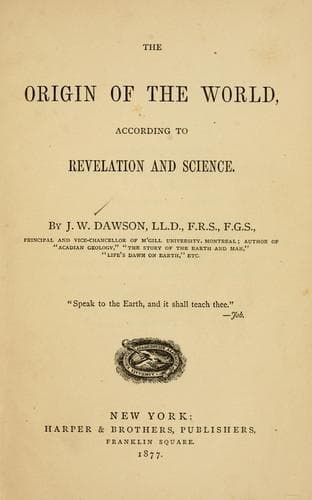
The Origin of the World According to Revelation and ScienceDawson, John William, Sir
Religion
The Origin of the World According to Revelation and Science
Dawson, John William, Sir
Bible and science; Religion and science
On comparing this statement with the answer of Job in the 26th
chapter, verse 5th, it would seem that the ungodly antediluvians were
supposed to be still under the waters; a belief quite intelligible if
the Caspian, which, on the latest and most probable views of the
locality of the events of this book, was not very remote from the
residence of Job,[105] was supposed to mark the position of the
pre-Noachic population, as the Dead Sea afterward did that of the
cities of the plain. Some of the dates assigned to the book of Job
would, however, render it possible that this last catastrophe is that
to which _he_ refers:
"The _Rephaim_ tremble from beneath
The waters and their inhabitants.
Sheol is naked before him,
And destruction hath no covering."
The word _Rephaim_ here has been variously rendered "shades of the
dead" and "giants." It is properly the family or national name of
certain tribes of gigantic Hamite men (the Anakim, Emim, etc.)
inhabiting Western Asia at a very remote period; and it must here
refer either to them or to the still earlier antediluvian
giants.[106]
It is also an important point to be noticed here that the narrative of
the deluge in Genesis is given as the testimony or record of an
eye-witness, and is to be so understood; and that the terms of the
record imply, not as usually held that all sorts of animals were taken
into Noah's ark, but only a selection, the character of which is
clearly indicated by a comparison of the five lists of animals given
in the narrative. Bearing this in mind, and noticing that the writer
tells of his own experience as to the rise of the water, the drifting
of the ark, the disappearance of all visible shore, and the sounding
fifteen cubits where a hill had before been, all the difficulties of
the narrative of the deluge will at once disappear. These difficulties
have in fact arisen from regarding the story as the composition of a
historian, not as what it manifestly is, the log or journal of a
contemporary, introduced with probably little change by the compiler
of the book.
Public-domain text, read in full here on John Shaqi.
Reviews
Reviews
No reviews yet
Be the first to share your thoughts on this work.
Elsewhere in the archive
Join the Discussion
Join the discussion
Sign in to leave a comment or review.
Sign InorCreate an account