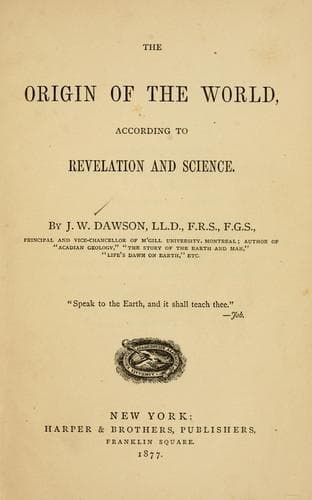
The Origin of the World According to Revelation and ScienceDawson, John William, Sir
Religion
The Origin of the World According to Revelation and Science
Dawson, John William, Sir
Bible and science; Religion and science
After the deluge, we find the human race settled in the plains of the
Euphrates and Tigris, attracted thither by the fertility of their
alluvial soils. There we find them engaging in a great political
scheme, no doubt founded on recollections of the old antediluvian
nationalities, and on a dread of the evils which able and aspiring men
would anticipate from that wide dispersion of the human race that
appears to have been intended by the Creator in the new circumstances
of the earth. They commenced accordingly the erection of a city or
tower at Babel, in the plain of Shinar, to form a common bond of
union, a great public work that should be a rallying-point for the
race, and around which its patriotism might concentrate itself. The
attempt was counteracted by an interposition of divine Providence; and
thenceforth the diffusion of the human race proceeded unchecked,
carrying with it everywhere the memory of the celebrated tower, which
perpetuated itself not only in the mounds of Assyria and Babylon and
the pyramids of Egypt, but in the teocallis and temple mounds of the
New World. The Babel enterprise is in fact the first recorded
development of that mound-building instinct which the earlier races
everywhere evince, and which has been a distinguishing characteristic
more especially of the Cushite or Turanian race, and has apparently
made them the teachers of constructive arts to all other peoples.
Perhaps a dread of the total decay and loss of the surviving
antediluvian arts in construction and other matters may have been one
impelling motive to the building of Babel. Perhaps it was connected
with the communistic ideas of the Turanian race, and their conflict
with the patriarchal habits of the Semites. Out of the enterprise at
Babel, however, arose a new type of evil, which, in the forms of
military despotism, the spirit of conquest, hero-worship, and the
alliance of these influences with literature and the arts, has been
handed down through every succeeding age to our own time. The name of
Nimrod, the son of Cush, has been preserved to us in the Bible, and
also apparently in the tablets and inscriptions of Assyria, as the
founder of the first despotism. This bold and ambitious man,
subsequently deified under different names, established a Hamite or
Turanian empire, which appears to have extended its sway over the
tribes occupying Southwestern Asia and Northeastern Africa, everywhere
supporting its power by force of arms, and introducing a debasing
polytheistic hero-worship, and certain forms of art probably derived
from antediluvian times. The centre of this Cushite empire, however,
gave way to the rising power of Assyria or the Ashurite branch of the
sons of Shem, at a period antecedent to the dawn of profane history,
except in its mythical form; and when the light of secular history
first breaks upon us, we find Egypt standing forth as the only stable
representative of the arts, the systems, and the superstitions of the
Public-domain text, read in full here on John Shaqi.
Reviews
Reviews
No reviews yet
Be the first to share your thoughts on this work.
Elsewhere in the archive
Join the Discussion
Join the discussion
Sign in to leave a comment or review.
Sign InorCreate an account