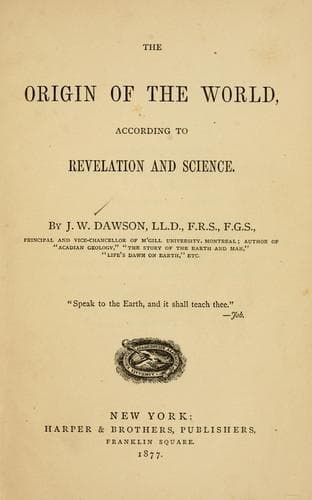
The Origin of the World According to Revelation and ScienceDawson, John William, Sir
Religion
The Origin of the World According to Revelation and Science
Dawson, John William, Sir
Bible and science; Religion and science
date of the dispersion of Babel, already a distinction of tongues
within each of the great races of men.
6. All the divisions of the family of Noah had from the first the
domesticated animals and the principal arts of life, and enjoyed these
in a national capacity so soon as sufficiently numerous. The more
scattered tribes, wandering into fresh regions, and adopting the life
of hunters, lost the characteristics of civilization, and diverged
widely from the primitive languages. We should thus have, according to
the Hebrew ethnology, a central area presenting the principal stems of
all the three races in a permanently civilized state. All around this
area should lie aberrant and often barbarous tribes, differing most
widely from the original type in the more distant regions, and in
those least favorable to human health and subsistence. In these
outlying regions, secondary centres of civilization might grow up,
differing from that of the primitive centre, except in so far as the
common principles of human nature and intercommunication might prevent
this. All these conclusions, fairly deducible at once from the Mosaic
ethnology and the theory of dispersion from a centre, are perfectly in
accordance with observed facts, though in absolute contradiction to
prevalent ethnological conclusions, based on these facts in connection
with theories of development.
A multitude of Bible notices might easily be quoted illustrative of
these points, and also of the consistency of the Mosaic narrative with
itself. One of them may suffice here. Abraham, who is said by the
Jews to have been contemporary with Shem, as Menes by the Egyptians
with Ham, at least lived sufficiently near to the time of the rise of
the earliest nations to be taken as an illustration of this primitive
condition of society. He was not a patriarch of the first or second
rank, like Ham or Mizraim or Canaan, but a subordinate family leader
several removes from the survivors of the deluge. Yet his tribe
increases in comparatively few years to a considerable number. He is
treated as an equal by the monarchs of Egypt and Philistia. He
defeats, with a band of three or four hundred retainers, a confederacy
of four Euphratean kings representing the embryo state of the Persian
and Assyrian empires, and already relatively so strong that they have
overrun much of Western Asia. All this bespeaks in a most consistent
manner the rapid rise of many small nationalities, scattered over the
better parts of wide regions, and still in a feeble condition, though
inheriting from their ancestors an old civilization, and laying the
foundations of powerful states. If we attach any historical value
whatever to the narrative, it obviously implies that at a date of
about two thousand years before Christ the regions afterward occupied
by the oldest historic empires were still thinly peopled, and their
dominant races little more than feeble tribes. This farther
Public-domain text, read in full here on John Shaqi.
Reviews
Reviews
No reviews yet
Be the first to share your thoughts on this work.
Elsewhere in the archive
Join the Discussion
Join the discussion
Sign in to leave a comment or review.
Sign InorCreate an account