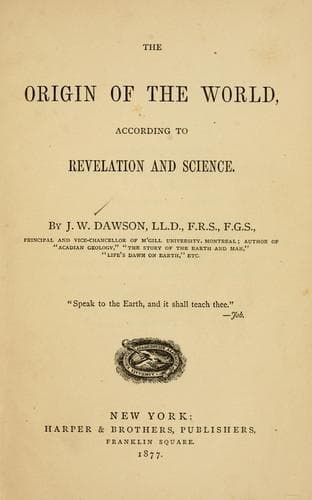
The Origin of the World According to Revelation and ScienceDawson, John William, Sir
Religion
The Origin of the World According to Revelation and Science
Dawson, John William, Sir
Bible and science; Religion and science
corresponds with the authentic history of all the ancient nations,
however these may have been extended by previous mythical periods.
About or shortly before the time of Abraham, Menes was draining for
the first time the swamps of Egypt, Ninus or Nimrod was founding the
Assyrian empire, the Phoenicians were founding Sidon, agriculture was
being introduced into China, the Vedas were being written in India,
the Persian monarchy was being founded; and, in short, all the
historical nations of the East were originating, and this apparently
by springing into being with an already formed civilization.
Such being the Hebrew account of the date and early history of man, it
may be proper here to compare it with such deductions from
archaeological and geological investigation as may seem to conflict
with it, and at the same time to make some comparisons with the
Turanian and Aryan traditions and speculations as to human origins.
The special lines of investigation important here are: 1. Early
historical records other than the Bible; 2. The diversity of human
languages; 3. The geological evidence afforded by remains of
prehistoric men found in caverns and other repositories. The last of
these is at present that which has attained the greatest development.
1. _Early Human History._--Had the human race everywhere preserved
historical records, we should have had some certain evidence as to the
places and times of origination of its tribes and peoples.
Unfortunately this has not been the case. All savage and barbarous
races, and many of those now civilized, have lost all records of their
early history. Most of the so-called ancient nations are comparatively
modern, and their history after a very short course loses itself in
uncertain tradition and mythical fancies. The only really ancient
nations that have given us in detail their own written history are the
Hebrews, the Assyrians, the Egyptians, the Hindoos, and the Chinese.
The last people, though professedly very ancient, trace their history
from a period of barbarism--a view confirmed by their physical
characters and the nature of their civilization; and on this account,
if no other, their history can not be considered as of much
archaeological value. According to their own records, their earliest
authentic history goes back to about 2800 B.C., and was preceded by a
prehistoric period of uncertain duration. The astronomical deductions
of Schlegel, which would extend their history to 17,000 years, are
evidently altogether unreliable.[112] The early Hindoo history is
palpably fabulous or distorted, and has been variously modified and
changed in comparatively modern times. There is one great and very
ancient people--the Egyptian--evidently civilized from the beginning
of all history, that have succeeded in transmitting to us, though only
in fragments, their primeval history; and of late years constant
additions have been made from inscribed tablets and monuments to our
Public-domain text, read in full here on John Shaqi.
Reviews
Reviews
No reviews yet
Be the first to share your thoughts on this work.
Elsewhere in the archive
Join the Discussion
Join the discussion
Sign in to leave a comment or review.
Sign InorCreate an account