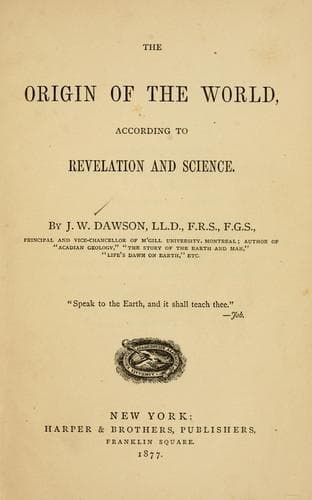
The Origin of the World According to Revelation and ScienceDawson, John William, Sir
Religion
The Origin of the World According to Revelation and Science
Dawson, John William, Sir
Bible and science; Religion and science
Possibly a more accurate measurement of time for particular regions of
the world might be deduced from the introduction of bronze and iron.
If the former was, as many antiquarians suppose, a local discovery in
Europe, and not introduced from abroad, it can give no measurement of
time whatever. In America, as the facts detailed by Dr. Wilson show,
while a bronze age existed in Peru, it was the copper age in the
Mississippi Valley, and the stone age elsewhere; and these conditions
might have co-existed for any length of time, and could give no
indication of relative dates. On the other hand, the iron introduced
by European commerce spread at once over the continent, and came into
use in the most remote tribes, and its introduction into America
clearly marks an historical epoch. With regard to bronze in Europe, we
must bear in mind that tin was to be procured only in England and
Spain, and in the latter in very small quantity; the mines of Saxony
do not seem to have been known till the Middle Ages. We must further
consider that tin ore is a substance not metallic in appearance, and
little likely to attract the attention of savages; and that, as we
gather from a hint of Pliny, it was probably first observed, in the
West at least, as stream tin, in the Spanish gold washings. Lastly,
when we place in connection with these considerations the fact that in
the earliest times of which we have certain knowledge, the tin trade
of Spain and England was monopolized by the Phoenicians, there seems
to be a strong probability that the extension of the trade of this
nation to the western Mediterranean really inaugurated the bronze
period. The only valid argument against this is the fact that moulds
and other indications of native bronze casting have been found in
Switzerland, Denmark, and elsewhere; but these show nothing more than
that the natives could recast bronze articles, just as the American
Indians can forge fish-hooks and knives out of nails and iron hoops.
Other considerations might be adduced in proof of this view, but our
limits will not permit us to refer to them. The important questions
still remain: When was this trade commenced, and how rapidly did it
extend itself from the sea-coast across Europe? The British tin trade
must have been in existence in the time of Herodotus, though his
notion of the locality was not more definite than that it was in the
extremity of the earth. The Phoenician settlements in the western
Mediterranean must have existed as early as the time of Solomon, when
"ships of Tarshish" was the general designation of seagoing ships for
long voyages. How long previously these colonies existed we do not
know; but considering the great scarcity and value of tin in those
very ancient times, we may infer that perhaps only the Spanish, and
not the British deposits were known thus early; or that the
Phoenicians had only indirect access to the latter. Perhaps we may fix
Public-domain text, read in full here on John Shaqi.
Reviews
Reviews
No reviews yet
Be the first to share your thoughts on this work.
Elsewhere in the archive
Join the Discussion
Join the discussion
Sign in to leave a comment or review.
Sign InorCreate an account