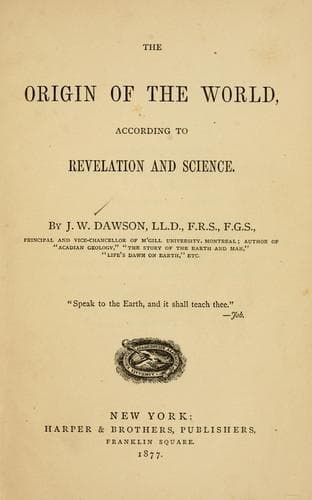
The Origin of the World According to Revelation and ScienceDawson, John William, Sir
Religion
The Origin of the World According to Revelation and Science
Dawson, John William, Sir
Bible and science; Religion and science
the time when these traders were able to supply the nations of Europe
with abundance of bronze in exchange for their products, at, say 1000
to 1200 B.C., as the earliest probable period; and possibly from one
to two centuries would be a sufficient allowance for the complete
penetration of the trade throughout Europe. But of course wars or
migrations might retard or accelerate the process; and there may have
been isolated spots in which a partial stone period extended up to
those comparatively recent times in which first the Greek trade, and
afterward the entire overthrow of the Carthaginian power by the
Romans, terminated forever the age of bronze and substituted the age
of iron. This would leave, according to our ordinary chronologies, at
least ten or fifteen centuries for the postdiluvian stone period in
Europe and Western Asia, a time quite sufficient in our view for all
that part of it represented by such monuments as the Danish
shell-heaps or the platform habitations of the Swiss lakes; leaving
the remains of the prehistoric caverns and river gravels for the
antediluvian period. A few facts in illustration of these points, and
also of the Biblical history, may be mentioned here.
We know perfectly that the early Chaldeans of the Euphratean valley
were acquainted with the use of metals--bronze certainly, and at a
very early date iron; yet flint knives and other implements of stone
are found under circumstances which show that they were used in the
palmy days of the Assyrian empire. The inhabitants of Egypt were
acquainted with bronze and iron long before the date of the Exodus,
yet the Egyptians used stone knives for some purposes up to a
comparatively modern time. Joshua used stone knives for the purpose of
circumcision; and according to Herodotus there were Ethiopians in the
army of Xerxes who used stone-tipped arrows. If any antiquarian were
to stumble on the "hill of the foreskins"--a mound under which were
buried in all probability the multitudinous flint flakes used in the
circumcision of the thousands of Israel--or the grave in which some of
the Ethiopian auxiliaries of Xerxes were buried with their flint
arrow-heads and javelins of antelopes' horn, how absurd would be the
inference that these repositories were of the palaeolithic age. Nay, so
late as 1870 a traveller was informed that the Bagos, a people of
Abyssinia, still made and used stone hatchets and flint knives.[121]
Public-domain text, read in full here on John Shaqi.
Reviews
Reviews
No reviews yet
Be the first to share your thoughts on this work.
Elsewhere in the archive
Join the Discussion
Join the discussion
Sign in to leave a comment or review.
Sign InorCreate an account