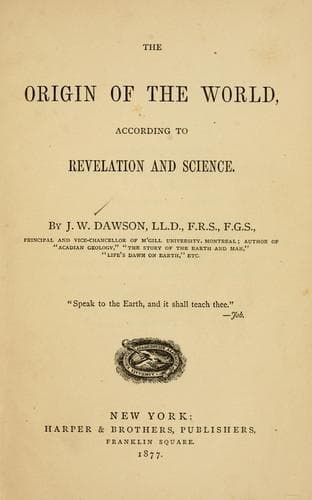
The Origin of the World According to Revelation and ScienceDawson, John William, Sir
Religion
The Origin of the World According to Revelation and Science
Dawson, John William, Sir
Bible and science; Religion and science
In Europe we find reason to believe that the Ligurians of Northwestern
Italy were flint-folk of very rude type until they were conquered by
the Gauls about 400 B.C.[122] Though the Gauls, Britons, and Germans
of the age of Julius Caesar had iron weapons, yet it is evident that
the metal was very scarce, and that bronze was more common; and in
confirmation of this it is found that in the trenches before Alize,
the Alesia of Caesar, where the final struggle of the Roman general
with Vercingetorix took place, weapons of stone, bronze, and iron are
intermixed. All over the more northern parts of Europe there is the
best reason to believe that the use of stone and bronze continued to a
much later period, and locally until long after the Christian era. It
is clear that such facts as these must greatly modify our ideas of the
probable age of the Swiss lake villages, and should induce the
greatest caution in claiming any special antiquity for particular
classes of implements.
One of the most remarkable discoveries of modern times is that of the
site of ancient Troy by Dr. Schliemann, and it affords clear and
decisive evidence as to the historic value of the ages to which we
have referred.
Troy was destroyed by the Greeks perhaps about 1300 B.C., and we know
from Homer that this was in what for the Greeks and Trojans may
properly be termed the copper age, weapons and armor of that metal
being in common use, and also the mode of burial by cremation. We may
well suppose that at that early date the stone age was still in full
force in Northern Europe and Asia, and in the mountains of
Switzerland; and as the tin mines of England had not yet been reached,
bronze was scarce and dear even in Eastern Europe and Asia. Now
Schliemann has disinterred the undoubted Trojan Ilium on the hill of
Hissarlik; but he finds it to be only one of several buried cities,
and the succession of strata will be most clearly seen in the section
on the following page, compiled from his clear and circumstantial
descriptions. It is needless to say that this presents a succession of
the stone age to one of comparatively high civilization. It also forms
an epitome of that of the whole East, and of primitive man in general,
in some very important respects. We have first, at a date probably
coeval with that of the earliest monarchies of Assyria and Egypt, a
primitive people whose arts and mode of life remind us strongly of the
American Toltecans and Peruvians.[123] Schliemann supposes them to
have been Aryan, but they were more probably of Turanian race. They
must have occupied the site for a very long time. They were succeeded
by a more cultivated people of fine physical organization, yet
possibly still Turanians or primitive Aryans, who by trade or plunder
had accumulated large stores of metallic wealth, and had made advances
in the arts of life placing them on a level with the early Phoenicians
and Egyptians, with whom they probably had intercourse. These
Public-domain text, read in full here on John Shaqi.
Reviews
Reviews
No reviews yet
Be the first to share your thoughts on this work.
Elsewhere in the archive
Join the Discussion
Join the discussion
Sign in to leave a comment or review.
Sign InorCreate an account