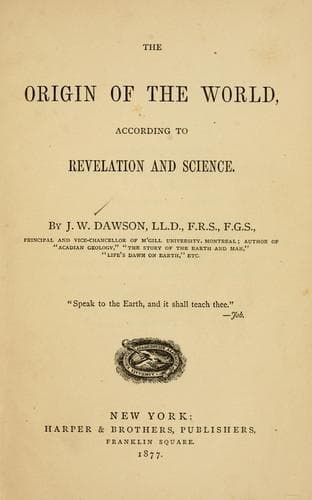
The Origin of the World According to Revelation and ScienceDawson, John William, Sir
Religion
The Origin of the World According to Revelation and Science
Dawson, John William, Sir
Bible and science; Religion and science
A convenient starting-point is afforded by the great group of
languages known as the Indo-European, Japhetic, or Aryan. From the
Ganges to the west coast of Ireland, through Indian, Persian, Greek,
Italian, German, Celt, runs one great language--the Sanscrit and the
dark Hindoo at one extreme, the Erse and the xanthous Celt at the
other. No one now doubts the affinity of this great belt of languages.
No one can pretend that any one of these nations learned its language
from another. They are all decided branches of a common stock. Lying
in and near this area are other nations--as the Arabs, the Syrians,
the Jews--speaking languages differing in words and structure--the
Semitic tongues. Do these mark a different origin? The philologists
answer in the negative, pointing to the features of resemblance which
still remain, and above all to certain intermediate tongues of so high
antiquity that they are rather to be regarded as root-stocks from
which other languages diverged than as mixtures. The principal of
these is the ancient Egyptian, represented by the inscriptions on the
monuments of that wonderful people, and by the more modern Coptic,
which, according to Bunsen and Latham, presents decided affinities to
both the great classes previously mentioned, and may be regarded as
strictly intermediate in its character. It has accordingly been
designated by the term Sub-Semitic.[127] But it shares this character
with all or nearly all the other African languages, which bear strong
marks of affinity to the Egyptian and Semitic tongues. On this
subject Dr. Latham says, "That the uniformity of languages throughout
Africa is greater than it is either in Asia or in Europe, is a
statement to which I have not the least hesitation in committing
myself."[128] To the north the Indo-European area is bounded by a
great group of semi-barbarous populations, mostly with Mongolian
features, and speaking languages which have been grouped as Turanian.
These Turanian languages, on the one hand, graduate without any break
into those of the Esquimaux and American Indians; on the other,
according to Mueller and Latham, they are united, though less
distinctly, with the Semitic and Japhetic tongues. They not improbably
represent in more or less altered forms the most primitive stock of
language from which both the Semitic and Japhetic groups have
branched. Another great area on the coasts and in the islands of the
Pacific is overspread by the Malay, which, through the populations of
Transgangetic India, connects itself with the great Indo-European
line. Mr. Edkins, in his remarkable book on "China's Place in
Philology," has collected a large amount of fact tending to show that
the early Chinese in its monosyllabic radicals presents root-forms
traceable into all the stocks of human speech in the Old World; and
the American languages would have furnished him with similar lines of
affinity. If we regard physical characters, manners, and customs, and
Public-domain text, read in full here on John Shaqi.
Reviews
Reviews
No reviews yet
Be the first to share your thoughts on this work.
Elsewhere in the archive
Join the Discussion
Join the discussion
Sign in to leave a comment or review.
Sign InorCreate an account