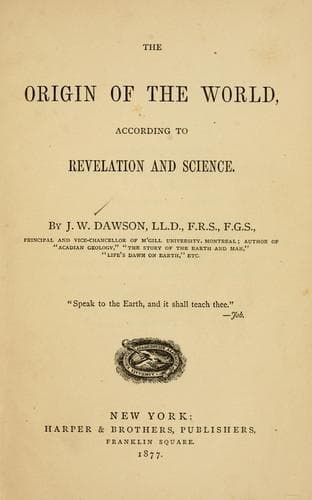
The Origin of the World According to Revelation and ScienceDawson, John William, Sir
Religion
The Origin of the World According to Revelation and Science
Dawson, John William, Sir
Bible and science; Religion and science
mythologies, as well as mere language, it is much easier thus to link
together nearly all the populations of the globe. In investigations of
this kind, it is true, the links of connection are often delicate and
evanescent; yet they have conveyed to the ablest investigators the
strong impression that the phenomena are rather those of division of a
radical language than of union of several radically distinct.
This impression is farther strengthened when we regard several results
incidental to these researches. Latham has shown that the languages of
men may be regarded as arranged in lines of divergence, the extreme
points of which are Fuego, Tasmania, Easter Island; and that from all
these points they converge to a common centre in Western Asia, where
we find a cluster of the most ancient and perfect languages; and even
Haeckel is obliged to adopt in his map of the affiliation of races of
men a similar scheme, though he, without any good historical or
scientific evidence, extends it back into the imaginary lost continent
of Lemuria. Farther, the languages of the various populations differ
in proceeding from these centres in a manner pointing to degeneracy
such as is likely to occur in small and rude tribes separating from a
parent stock. These lines of radiation follow the most easy and
probable lines of migration of the human race spreading from one
centre. It must also be observed that in the primary migration of men,
there must of necessity have been at its extreme limits outlying and
isolated tribes, placed in circumstances in which language would very
rapidly change; especially as these tribes, migrating or driven
forward, would be continually arriving at new regions presenting new
circumstances and objects. When at length the utmost limit in any
direction was reached, the inroads of new races of population would
press into close contact these various tribes with their different
dialects. Where the distance was greatest before reaching this limit,
we might expect, as in America, to find the greatest mutual variety
and amount of difference from the original stock. After the primary
migration had terminated, the displacements arising from secondary
migrations and conquests, would necessarily complicate the matter by
breaking up the original gradations of difference, and thereby
rendering lines of migration difficult to trace.
Taking all these points into the account, along with the known
tendencies of languages in all circumstances to vary, it is really
wonderful that philology is still able to give so decided indications
of unity.
Public-domain text, read in full here on John Shaqi.
Reviews
Reviews
No reviews yet
Be the first to share your thoughts on this work.
Elsewhere in the archive
Join the Discussion
Join the discussion
Sign in to leave a comment or review.
Sign InorCreate an account