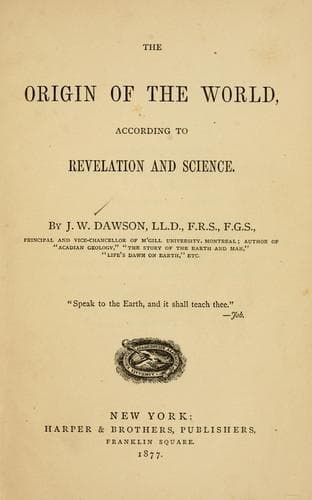
The Origin of the World According to Revelation and ScienceDawson, John William, Sir
Religion
The Origin of the World According to Revelation and Science
Dawson, John William, Sir
Bible and science; Religion and science
The caverns themselves may be divided into those of residence, of
sepulture, and of driftage, though one cavern has often successively
assumed two at least of these characters. In the caverns of residence
large accumulations have been formed of ashes, charcoal, bones, and
other debris of cookery, among which are found flint and bone
implements, the general character of which, as well as that of the
needles, stone hammers, mortars for paint, and other domestic
appliances, are not more dissimilar from those of the Red Indian and
Esquimau races in North America than these are from one another, and
in many things, as in the bone harpoons, the resemblance is very
striking indeed. In tendency to imitative art, and in the skill of
their delineations of animals, the prehistoric men seem to have
surpassed all the American races except the semi-civilized
mound-builders and the more cultivated Mexican and Peruvian nations.
With regard to the residence of these men of the mammoth age in
caverns, several things are indicated by American analogies to which
some attention should be paid.
It is not likely that caverns were the usual places of residence of
the whole population. They may have been winter houses for small
tribes and detached families of fugitives or outlaws, or they may have
been places of resort for hunting parties at certain seasons of the
year. The large quantities of broken and uncooked bones of particular
species, as of the horse and reindeer, in some of the caverns, would
farther indicate a habit of making great battues, like those of the
American hunting tribes, at certain seasons, and of preparing
quantities of pemmican or dried meat preserved with marrow and fat for
future use. The number of bone needles found in some of the caves
would seem to hint that, like the Americans, they sewed up their
pemmican in skin bags. The multitude of flint flakes and of rude stone
implements applicable to breaking bones certainly indicates a
wholesale cutting of flesh and preparation of marrow. In the "Story of
the Earth," I have suggested in connection with this that there may
have been towns or villages of these people unknown to us, and which
would afford higher conceptions of their progress in the arts. This
anticipation appears recently to have been realized in the discovery
of such a town or fortified village of the mammoth age at Soloutre, in
France, and which seems to afford evidence that these ancient people
had already domesticated the horse, using it as food as well as a
beast of burden, in the manner of the Khirgis and certain other Tartar
tribes of Central Asia.[135] This, with the undoubtedly high cerebral
organization indicated by the skulls of the mammoth age, notably
raises our estimate of the position of man at this early date.
Public-domain text, read in full here on John Shaqi.
Reviews
Reviews
No reviews yet
Be the first to share your thoughts on this work.
Elsewhere in the archive
Join the Discussion
Join the discussion
Sign in to leave a comment or review.
Sign InorCreate an account