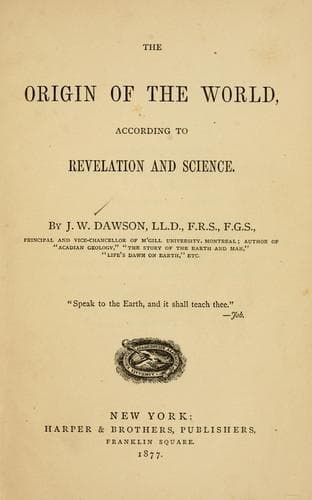
The Origin of the World According to Revelation and ScienceDawson, John William, Sir
Religion
The Origin of the World According to Revelation and Science
Dawson, John William, Sir
Bible and science; Religion and science
With regard to caves of sepulture, the same remark may be made as with
regard to the caves of residence. They do not seem to have been the
burial-places of large populations, but only occasional places of
interment, few bodies being found in them, and these often interred in
the midst of culinary debris, evidencing previous or contemporary
residence. With regard to the latter, it seems to have been no
uncommon practice with some North American tribes to bury the dead
either in the floors of their huts or in their immediate proximity. It
is probable, however, that the few examples known of caves of
sepulture of this period indicate not tribal or national places of
burial, but occasional and accidental cases, happening to hunting or
war parties, perhaps remote from their ordinary places of residence.
In so far as method of burial is concerned, the men of the Palaeocosmic
or Mammoth age seem to have buried the dead extended at full length,
and not in the crouching posture usual with some later races. Like the
Americans, they painted the dead man, and buried him with his robes
and ornaments, and probably with his weapons, thus intimating their
belief in happy hunting-grounds beyond the grave.[136] I may remark
here that all the known interments of the mammoth age indicate a race
of men of great cerebral capacity, with long heads and coarsely marked
features, of large stature and muscular vigor, surpassing indeed much
in all these respects the average man of modern Europe. These
characteristics befit men who had to contend with the mammoth and his
contemporaries, and to subdue the then vast wildernesses of the
eastern continent, and they correspond with the Biblical
characteristics of antediluvian man.
Among caves of driftage may be classed some of those near Liege, in
Belgium, and, partially at least, those of Kent's Hole and Brixham, in
England. In these only disarticulated remnants of human skeletons, or
more frequently only flint implements, some of them of doubtful
character, have been found. In my "Story of the Earth," I have taken
the carefully explored Kent's Cavern of Torquay as a typical example,
and have condensed its phenomena as described by Mr. Pengelly. I now
repeat this description, with some important emendations suggested by
that gentleman in more recent reports and in private correspondence.
The somewhat extensive and ramifying cavern of Kent's Hole is an
irregular excavation, evidently due partly to fissures or joints in
limestone rock, and partly to the erosive action of water enlarging
such fissures into chambers and galleries. At what time it was
originally cut we do not know, but it must have existed as a cavern at
the close of the Pliocene or beginning of the Post-pliocene period,
since which time it has been receiving a series of deposits which have
quite filled up some of its smaller branches.
Public-domain text, read in full here on John Shaqi.
Reviews
Reviews
No reviews yet
Be the first to share your thoughts on this work.
Elsewhere in the archive
Join the Discussion
Join the discussion
Sign in to leave a comment or review.
Sign InorCreate an account