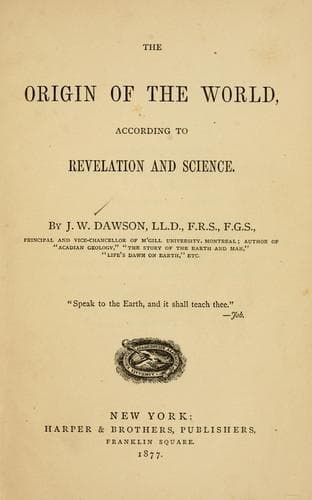
The Origin of the World According to Revelation and ScienceDawson, John William, Sir
Religion
The Origin of the World According to Revelation and Science
Dawson, John William, Sir
Bible and science; Religion and science
After the old stalagmite floor above mentioned was formed, the cave
again received deposits of muddy water and stones; but now a change
occurs in the remains embedded. This stony clay, or "cave earth," has
yielded an immense quantity of teeth and bones, including those of the
elephant, rhinoceros, horse, hyena, cave bear, reindeer, and Irish
elk. With these were found weapons of chipped flint, and harpoons,
needles, and bodkins of bone, precisely similar to those of the North
American Indians and other rude races. The "cave earth" is four feet
or more in thickness. It is not stratified, and contains many fallen
fragments of rock, rounded stones, and broken pieces of stalagmite. It
also has patches of the excrement of hyenas, which the explorers
suppose to indicate the temporary residence of these animals; and
besides fragments of charcoal scattered in the mass, there is in one
spot, near the top, a limited layer of burned wood, with remains which
indicate the cooking and eating of repasts of animal food by man. It
is clear that when this bed was formed the cavern was liable to be
inundated with muddy water, carrying stones and perhaps some of the
bones and implements, and breaking up in places the old stalagmite
floor.[137] One of the most puzzling features, especially to those who
take an exclusively uniformitarian view, is that the entrance of
water-borne mud and stones implies a level of the bottom of the water
in the neighboring valleys of nearly one hundred feet above its
present height. The cave earth is covered by a second crust of
stalagmite, less dense and thick than that below, and containing only
a few bones, which are of the same general character with those
beneath, but include a fragment of a human jaw with teeth. Evidently
when this stalagmite was formed the influx of water-borne materials
had ceased, or nearly so; and Mr. Pengelly appears to affirm, though
without assigning any reason, that none of these bones could, like
the masses of stalagmite, have been lifted from lower beds, or washed
into the cave from without.
The next bed marks a new change. It is a layer of black mould from
three to ten inches thick. Its microscopic structure does not seem to
have been examined; but it is probably a forest soil, introduced by
growth, by water, by wind, and by ingress of animals, all of them
modern, and contains works of art from the old British times before
the Roman invasion up to the porter bottles and dropped half-pence of
modern visitors. Lastly, in and upon the black mould are many fallen
blocks from the roof of the cave.
Public-domain text, read in full here on John Shaqi.
Reviews
Reviews
No reviews yet
Be the first to share your thoughts on this work.
Elsewhere in the archive
Join the Discussion
Join the discussion
Sign in to leave a comment or review.
Sign InorCreate an account