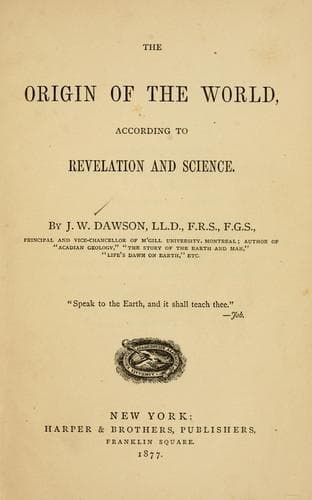
The Origin of the World According to Revelation and ScienceDawson, John William, Sir
Religion
The Origin of the World According to Revelation and Science
Dawson, John William, Sir
Bible and science; Religion and science
There can be no doubt that this cave and the neighboring one of
Brixham have done very much to impress the minds of British geologists
with ideas of the great antiquity of man; and they have, more than any
other postglacial monuments, shown the existence of some animals now
extinct up to the human age. Of precise data for determining time,
they have, however, given nothing. The only measures which seem to
have been applied, namely, the rate of growth of stalagmite and the
rate of erosion of neighboring valleys, are, from the very sequence of
the deposits, obviously worthless; and the only apparently constant
measure, namely, the fall of blocks from the roof, seems not to have
been applied, and Mr. Pengelly declares that it can not be practically
used. We are therefore quite uncertain as to the number of centuries
involved in the filling of this cave, and must remain so until some
surer system of calculation can be devised. We may, however, attempt
to sketch the series of events which it indicates.
The animals found in Kent's Hole are all "postglacial," some of them
of course survivors from "preglacial" times, and some of them still
surviving. They therefore inhabited the country after it rose from the
great glacial submergence. Perhaps the first colonists of the coast of
Devonshire in this period were the cave bears, migrating on floating
ice, and subsisting like the arctic bear and the black bear of
Anti-costi, on fish, and on the garbage cast up by the sea. They may
have found Kent's Hole a sea-side cavern, with perhaps some of its
galleries still full of water and filling with breccia, with which the
bones of dead bears became mixed. In the case of such a deposit as
this breccia, however, the precise time when its materials were
finally laid down in their present form, or the length of time
necessary for its accumulation, can not be definitely settled. It may
be a result of continued torrential action or of some sudden
cataclysm. As the land rose, these creatures for the most part betook
themselves to lower levels, and in process of time the cavern stood
upon a hill-side, perhaps several hundreds of feet above the sea; and
the mountain streams, their beds not yet emptied of glacial detritus,
washed into it stones and mud, and probably bones also, while it
appears that hyenas occupied the cave at intervals, and dragged in
remains of mammals of many species which had now swarmed across the
plains elevated out of the sea, and multiplied in the land. This was
the time of the cave earth; and before its deposit was completed,
though how long before an unstratified and therefore probably
often-disturbed bed of this kind can not tell, man himself seems to
have been added to the inhabitants of the British land. In pursuit of
game he sometimes ascended the valleys beyond the cavern, or even
penetrated into its outer chambers; or perhaps there were even in
those days rude and savage hill-men, inhabiting the forests and
Public-domain text, read in full here on John Shaqi.
Reviews
Reviews
No reviews yet
Be the first to share your thoughts on this work.
Elsewhere in the archive
Join the Discussion
Join the discussion
Sign in to leave a comment or review.
Sign InorCreate an account