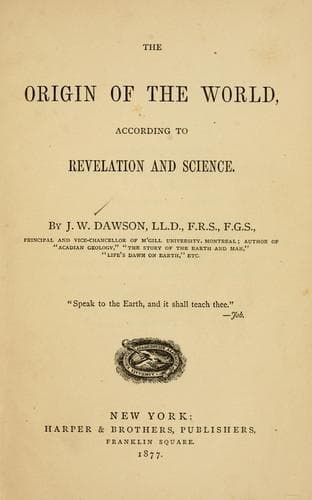
The Origin of the World According to Revelation and ScienceDawson, John William, Sir
Religion
The Origin of the World According to Revelation and Science
Dawson, John William, Sir
Bible and science; Religion and science
This leads us next to consider the occurrence of human remains and
objects of art in the river-gravels themselves, and the amount of
excavation and deposit involved in the deposition of these gravels.
In the river-gravels of the Somme, and of many other rivers in France
and Southern England, chipped flints and rude flint implements are
found in so great quantity as to imply that the beds and banks of
these streams were resorted to for flint material, and that the
unfinished and rejected implements left in the holes and trenches, or
on the heaps where the work was carried on, were afterward sorted by
running water, perhaps in abnormal floods and debacles, such as occur
in all river valleys occasionally, perhaps in that great diluvial
catastrophe which seems to have terminated the residence of
Palaeocosmic man in Europe. Wilson has well shown how the heaps left by
American tribes in and near their flint quarries would furnish the
material for such accumulations. The time required for the erosion of
the valleys and the deposit of the gravels has been very variously
estimated. In the case of the Somme, which river is not appreciably
deepening its bed, if we suppose it to have cut its wide valley to the
depth of one hundred and fifty feet out of solid chalk since the
so-called "high level" gravels of France and the South of England were
deposited, the time required shades off into infinity. So Evans, in
his work on "The Ancient Stone Implements of Great Britain," looking
upon the amount of excavation of wide and deep valleys since the stone
implements of Bournemouth are supposed to have been deposited in
gravel, says, "Who can fully comprehend how immensely remote was the
epoch when that vast bay was high and dry land?" and he becomes
poetical in delineating the view that must have met the eyes of
"palaeolithic" man. And undoubtedly, if one is to be limited to the
precise nature and amount of causes now at work in the district, the
time must not only be "immensely remote," but illimitably so. The
difficulty lies with the exaggerated uniformitarianism of the
supposition that such causes could have produced the results. But,
for reasons to be immediately stated, the time required is liable to
numerous deductions; and recently Tylor, Pattison, Collard, and others
have insisted ably on these deductions, as has also Professor Hughes,
of Cambridge. I have myself urged them strongly in the work already
referred to.
Public-domain text, read in full here on John Shaqi.
Reviews
Reviews
No reviews yet
Be the first to share your thoughts on this work.
Elsewhere in the archive
Join the Discussion
Join the discussion
Sign in to leave a comment or review.
Sign InorCreate an account