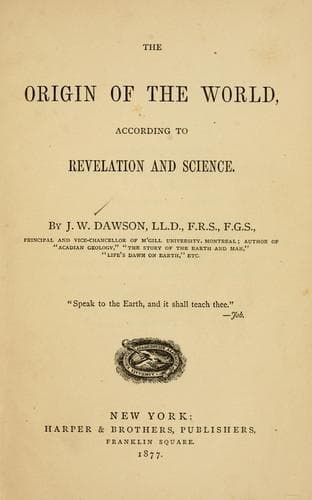
The Origin of the World According to Revelation and ScienceDawson, John William, Sir
Religion
The Origin of the World According to Revelation and Science
Dawson, John William, Sir
Bible and science; Religion and science
In the first place, when we see a deep river valley in which the
present stream is doing an almost infinitesimal amount of deepening,
we are not to infer that this represents all its work past and
present. In times of unusual flood it may do in one week more than in
many previous years. Farther, if there have been elevations or
depressions of the land, when the land has been raised the cutting
power has at once been enormously increased, and when depressed it has
been diminished, or filling has taken the place of cutting. Again, if
the climate in time past has been more extreme, or the amount of
rainfall greater, the cutting action has then been proportionally
rapid. Perhaps no influence is greater in this respect than that which
is known to the colonists in Northeastern America as "ice-freshets,"
when in spring, before the ice has had time to disappear from the
rivers, sudden thaws and rains produce great floods, which rushing
down over the icy crust, or breaking and hurling its masses before
them, work terrible havoc on the banks and alluvial flats, depositing
great beds of gravel, and sweeping away immense masses that had lain
undisturbed for centuries. Now we know that in Europe the human period
was preceded by what has been termed the glacial age, and as it was
passing away there must have been unexampled floods and ice-freshets,
and a temporary "pluvial period," as it has been called, in which the
volume of the rivers was immensely increased. Farther, it is an
established fact that the period of the appearance of man was a time
when the continents in the northern hemisphere were more elevated
than at present, and when consequently the cutting action of rivers
was at a maximum. This was again followed by a period of depression,
accompanied probably by many local cataclysms, if not by a general
deluge; and there are strong geological reasons to believe that this
convulsion was connected with the disappearance from Europe of
Palaeocosmic man, and many of the animals his contemporaries. This view
I advocated some time ago in my "Story of the Earth;" and more
recently Mr. Pattison, in an able paper read before the Victoria
Institute, has developed it in greater detail, and supported it by a
great mass of geological authority. If the Palaeocosmic period was one
of continental elevation, when the greater seats of population were in
the valleys of great rivers now covered by the German Ocean and the
English Channel, and when the valleys of the Thames and the Somme were
those of upland streams frequented by straggling parties and small
tribes, and the seats of extensive flint factories for the supply of
the plains below, and if this state of things was terminated by a
diluvial debacle, we can account for all the phenomena of the drift
implements without any extravagant estimate of time.
Public-domain text, read in full here on John Shaqi.
Reviews
Reviews
No reviews yet
Be the first to share your thoughts on this work.
Elsewhere in the archive
Join the Discussion
Join the discussion
Sign in to leave a comment or review.
Sign InorCreate an account