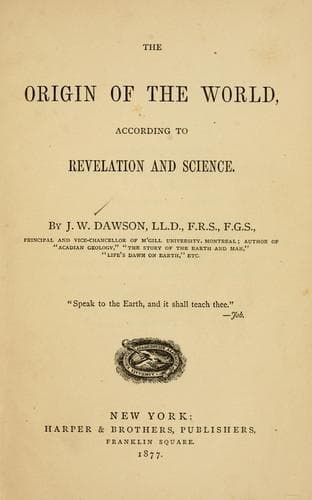
The Origin of the World According to Revelation and ScienceDawson, John William, Sir
Religion
The Origin of the World According to Revelation and Science
Dawson, John William, Sir
Bible and science; Religion and science
"A small upheaval near the mouth of a river would have a similar
effect. The Thames below London and the Somme below St. Acheul can now
only just hand on the mud brought down from higher ground; but suppose
an elevation of a hundred feet over those parts of England and France
(quite imperceptible if extended over 10,000, 1000, or even 100
years), and the rivers would tumble over soft mud and clay and chalk,
and soon eat their way back from Sheppey to London, and from St.
Valery to Amiens.
"So when we want to estimate the age of the gravels on the top of the
cliff at the Reculvers, or on the edge of the plateau of St. Acheul,
we have to ask, not how long would it take the rivers to cut down to
their present level from the height of those gravels at the rate at
which that part of their channel is being lowered now, but how long
would it take the Somme or Thames, which once ran at the level of
those gravels, to cut back from where its mouth or next waterfall was
then to where it runs over rapids now. We ought to know what movements
of upheaval and depression there have been; what long alluvial flats
or lakes which may have checked floods, but also arrested the
rock-protecting gravel; how much the wash of the estuarine waves has
helped. In fact, it is clear that observations made on the action of
the rivers at those points now have nothing to do with the calculation
of the age of the terraces above, and that the circumstances upon
which the rate of recession of the waterfalls and rapids depends are
so numerous and changeable that it is at present unsafe to attempt any
estimate of the time required to produce the results observed."
I may close this discussion by quoting from the paper of my friend Mr.
Pattison, already referred to, the following summing up of his
conclusions, in which I fully concur:
"We may assume it as established that there was a time when
England was connected with the Continent, when big animals
roamed in summer up the watercourses and across the uplands,
and man, armed only with rude stones, followed them into the
marshes and woods, hunted them for sustenance, and consumed
them in shelter of caves, then accessible from the river
levels. This state of things was continued until disturbed
by oscillations of surface, accompanied by excessive
rainfalls and rushes of water from the water-sheds of the
rivers, until the great animals were driven out or
destroyed, and man ceased to visit these parts. The
disturbances continued, the Strait of Dover was formed, the
configuration of the soft parts of the islands and
continents was fixed, action subsided, and the present state
of things obtained. Man resumed his residence, but with loss
of the mammoth and its companions. The reindeer now
constituted the type of a state of things which lasted down
to the historic period, without any other from that time to
this. * * *
Public-domain text, read in full here on John Shaqi.
Reviews
Reviews
No reviews yet
Be the first to share your thoughts on this work.
Elsewhere in the archive
Join the Discussion
Join the discussion
Sign in to leave a comment or review.
Sign InorCreate an account