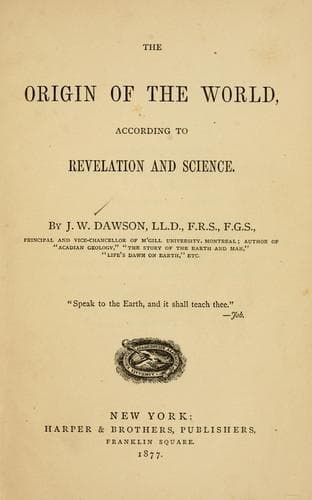
The Origin of the World According to Revelation and ScienceDawson, John William, Sir
Religion
The Origin of the World According to Revelation and Science
Dawson, John William, Sir
Bible and science; Religion and science
"Chronologists are agreed that about 2000 years B.C. Abraham
migrated from Mesopotamia to Canaan, and that at this time
Egypt at least was old in civilization. Beyond this we have
no positive scale of time in Scripture; for it is evident,
from the narrative itself, that the latter does not cover
the whole time. * * *
"Ussher estimates from Scripture the creation of man as
about 2000 years before this. During the latter portion of
this time civilization was proceeding under settled
governments in the East, interrupted, says the record and
tradition, by a flood. * * *
"So Lucretius:
'Thus, too, the insurgent waters once o'erpowered,
As fables tell, and deluged many a state;
Till, in its turn, the congregated waves
By cause more potent conquered, heaven restrain'd
Its ceaseless torrents, and the flood decreased.'
Barbarism covered the whole Western world; neither in the
2000 years before Abraham, nor in the 2000 years afterward,
have we any light reflected from these regions to the East.
In this 4000 years, or in the somewhat longer period which
probably will be ultimately settled as warranted by the
record, we place hypothetically all the phenomena of the
later mammalian age, including the introduction of man as a
hunter, the first occupation of the caves by him also, the
diluvial phenomena of the wide valleys, the oscillations and
disturbances of the earth's crust, alterations in the
coast-line, and physical settlement of the country; after
this comes the second occupation of the caves. In short, if
we say that, hypothetically, the whole first known human age
occurred within 4000 years of the Christian era, no one can
say that it is geologically impossible. Who can say that
1643 years is insufficient to comprise all the phenomena
that occurred during a period confessedly characterized by
more rapid and extensive action than at present--a period
during which ruptures in the earth's crust, oscillations,
and permanent uprising took place, and the intermittent
action of violent floods caused the deposit and disturbance
and resettlement of the gravels and brick-earth? There is
nothing to interfere with the prevalent opinion that man was
introduced here while the glacial period was dying out, and
while it was still furnishing flood-waters sufficient to
scour and re-sort the gravels of the valleys down which they
flowed. This supposition may be extended to both the great
continents."
Public-domain text, read in full here on John Shaqi.
Reviews
Reviews
No reviews yet
Be the first to share your thoughts on this work.
Elsewhere in the archive
Join the Discussion
Join the discussion
Sign in to leave a comment or review.
Sign InorCreate an account