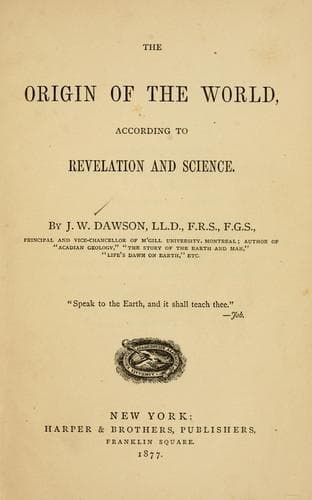
The Origin of the World According to Revelation and ScienceDawson, John William, Sir
Religion
The Origin of the World According to Revelation and Science
Dawson, John William, Sir
Bible and science; Religion and science
To conclude: Our mode of reconciling the Mosaic history of
antediluvian man with the disclosures of the gravels and caves would
be to identify Palaeocosmic man, or man of the mammoth age, with
antediluvian man; to suppose that the changes which closed his
existence in Europe as well as Western Asia were those recorded in the
Noachian deluge; and that the second colonization of the diminished
and shrunken Europe of the modern period was effected by the
descendants of Noah. It may be asked--Must we suppose that the Adam of
the Bible was of the type of the coarsely featured and gigantic men of
the European caverns? I would answer--Not precisely so; but it is
quite possible that Adam may have been Turanian in feature. We should
certainly suppose him to have been a man well developed in brain and
muscle. Such men as those found in the caves would rather represent
the ruder "Nephelim," the "giants that were in those days," than Adam
in Eden. Farther, the new colonists of Europe after the deluge would
no doubt be a very rude and somewhat degenerate branch of Noachidae,
probably driven before more powerful tribes in the course of the
dispersion. The higher races of both periods are probably to be looked
for in Western Asia; but even there we must expect to find cave men
like those whose remains were found by Tristram in the caves near
Tyre, and like the Horim of Moses; and we must also expect to find the
antediluvian age in the main an age of stone everywhere, and its arts,
except in certain great centres of population, perhaps not more
advanced than those of the Polynesians, or those of the agricultural
American tribes before the discovery of America by Columbus.
As a geologist, and as one who has been in the main of the school of
Lyell, and after having observed with much care the deposits of the
more modern periods on both sides of the Atlantic, I have from the
first dissented from those of my scientific brethren who have
unhesitatingly given their adhesion to the long periods claimed for
human history, and have maintained that their hasty conclusions on
this subject must bring geological reasoning into disrepute, and react
injuriously on our noble science. We require to make great demands on
time for the prehuman periods of the earth's history, but not more
than sacred history is willing to allow for the modern or human age.
CHAPTER XV.
COMPARISONS AND CONCLUSIONS.
"Lo, these are but the outlines of his ways, and how faint
the whisper which we hear of him--the thunder of his power
who could understand?"--Job xxvi., 14.
Public-domain text, read in full here on John Shaqi.
Reviews
Reviews
No reviews yet
Be the first to share your thoughts on this work.
Elsewhere in the archive
Join the Discussion
Join the discussion
Sign in to leave a comment or review.
Sign InorCreate an account