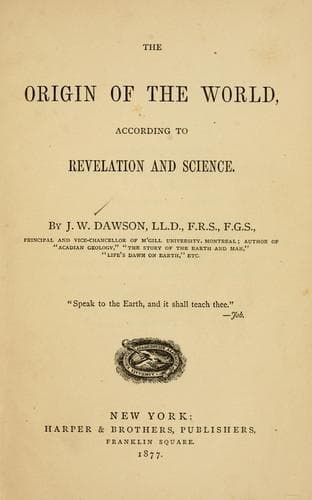
The Origin of the World According to Revelation and ScienceDawson, John William, Sir
Religion
The Origin of the World According to Revelation and Science
Dawson, John William, Sir
Bible and science; Religion and science
1. The widest and most important generalization of modern geology is
that all the materials of the earth's crust, to the greatest depth
that man can reach, either by actual excavation or inference from
superficial arrangements, are of such a nature as to prove that they
are not, in their present state, original portions of the earth's
structure; but that they are the results of the operation, during long
periods, of the causes of change--whether mechanical, chemical, or
vital--now in operation, on the land, in the seas, and in the interior
of the earth. For example, the most common rocks of our continents are
conglomerates, sandstones, shales, and slates; all of which are made
up of the debris of older rocks broken down into gravel, sand, or mud,
and then re-cemented. To these we may add limestones, which have been
made up by the accumulation of corals and shells, or by deposits from
calcareous springs; coal, composed of vegetable matter; and granite,
syenite, greenstone, and trap, which are molten rocks formed in the
manner of modern lavas. So general has been this sorting, altering,
and disturbance of the substance of the earth's crust, that, though we
know its structure over large portions of our continents to the depth
of several miles, the geologist can point to no instance of a truly
primitive rock which can be affirmed to have remained unchanged and
_in situ_ since the beginning.
"All are aware that the solid parts of the earth consist of distinct
substances, such as clay, chalk, sand, limestone, coal, slate,
granite, and the like; but, previously to observation, it is commonly
imagined that all had remained from the first in the state in which we
now see them--that they were created in their present forms and in
their present position. The geologist now comes to a different
conclusion; discovering proofs that the external parts of the earth
were not all produced in the beginning of things in the state in which
we now behold them, nor in an instant of time. On the contrary, he can
show that they have acquired their actual condition and configuration
gradually and at successive periods, during each of which distinct
races of living beings have flourished on the land and in the waters;
the remains of these creatures lying buried in the crust of the
earth."[140]
Public-domain text, read in full here on John Shaqi.
Reviews
Reviews
No reviews yet
Be the first to share your thoughts on this work.
Elsewhere in the archive
Join the Discussion
Join the discussion
Sign in to leave a comment or review.
Sign InorCreate an account