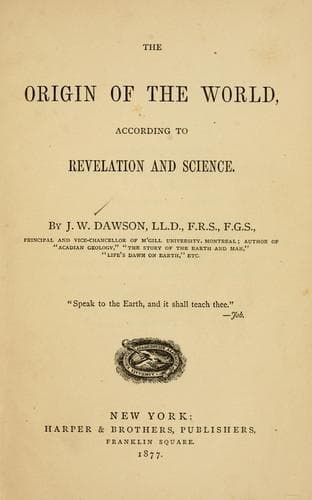
The Origin of the World According to Revelation and ScienceDawson, John William, Sir
Religion
The Origin of the World According to Revelation and Science
Dawson, John William, Sir
Bible and science; Religion and science
2. Having ascertained that the rocks of the earth have thus been
produced by secondary causes, we next affirm, on the evidence of
geology, that a distinct order of succession of these deposits can be
ascertained; and though there are innumerable local variations in the
nature of the rocks formed at the same period, yet there is, on the
great scale, a regular sequence of formations over the whole earth.
This succession is of the greatest importance in the case of aqueous
rocks, or those formed in water; and it is evident that in the case of
beds of sand, clay, etc., deposited in this way, the upper must be the
more recent of any two layers. This simple principle, complicated in
various ways by the fractures and disturbances to which the beds have
been subjected, forms the basis of the succession of "formations" in
geology as deduced from stratigraphical evidence.
3. This regular series of formations would be of little value as a
history of the earth were it not that nearly all the aqueous rocks
contain remains of the contemporary animals and plants. Ever since
the earth began to be tenanted by organized beings, the various
accumulations formed in the bottoms of seas and at the mouths of
rivers have entombed remains of marine animals, more especially their
harder parts, as shells, corals, and bones, and also fragments or
entire specimens of land animals and plants. Hence, in any rock of
aqueous formation, we may find fossil remains of the living creatures
that existed in the waters in which that rock was accumulated or on
the neighboring land. If in the process of building up the continents,
the same locality constituted in succession a part of the bottom of
the ocean, of an inland sea, of an estuary, and a lake, we should find
in the fossil remains entombed in the deposits of that place evidences
of these various conditions; and thus a somewhat curious history of
local changes might be obtained. Geology affords more extensive
disclosures of this nature. It shows that as we descend into the older
formations we gradually lose sight of the existing animals and plants,
and find the remains of others not now existing; and these, in turn,
themselves disappear, and were preceded by others; so that the whole
living population of the earth appears to have been several times
renewed prior to the beginning of the present order of things. This
seems farther to have occurred in a slow and gradual manner, not by
successive great cataclysms or clearances of the surface of the earth,
followed by wholesale renewal. This doctrine of geological uniformity
is, however, to be understood as limited by the equally certain fact
that there has been progress and advance, both in the inorganic
arrangements of the earth's surface and in its organized inhabitants,
and that there have, in geological as in historical times, been local
cataclysms and convulsions, as those of earthquakes and volcanoes,
often on a very extensive scale. Farther, there are good reasons to
Public-domain text, read in full here on John Shaqi.
Reviews
Reviews
No reviews yet
Be the first to share your thoughts on this work.
Elsewhere in the archive
Join the Discussion
Join the discussion
Sign in to leave a comment or review.
Sign InorCreate an account