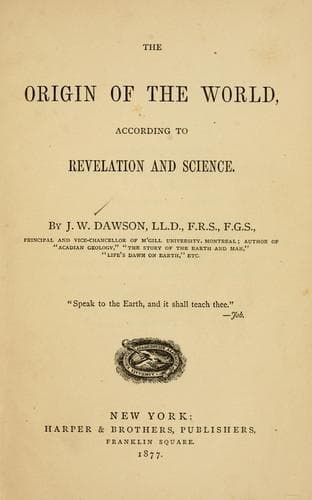
The Origin of the World According to Revelation and ScienceDawson, John William, Sir
Religion
The Origin of the World According to Revelation and Science
Dawson, John William, Sir
Bible and science; Religion and science
We have already, in previous chapters, noticed the parallelism of the
succession of life in the earth as revealed in Genesis with that
disclosed by geology; but this subject must be farther referred to in
the sequel, and in the mean time the reader may compare for himself
the succession of life in the table with that in the later creative
days.
5. The lapse of time embraced in the geological history of the earth
is enormous. Fully to appreciate this it is necessary to study the
science in detail, and to explore its phenomena as disclosed in actual
nature. A few facts, however, out of hundreds which might have been
selected, will suffice to indicate the state of the case. The delta
and alluvial plain of the Mississippi have an area of more than 12,000
square miles, and must have an average depth of about 800 feet. At the
present rate of conveyance of sediment by the river, it has been
calculated that a period of about 33,000 years is implied in the
deposition of this comparatively modern formation.[143] To be quite
safe, let us take 30,000 years, and add 50,000 more for the remainder
of the Post-pliocene or Quaternary. We may then safely multiply this
number by forty, for the length of the Tertiary period. We may add
three times as much for the Mesozoic period, and this will be far
under the truth. It will then be quite safe to assume that the
Palaeozoic period was three times as long as the Mesozoic and Tertiary
together. This would give altogether, say, 51,280,000 years for the
whole of geological time from the beginning of the Palaeozoic, leaving
the duration of the Eozoic and previous periods undetermined, but
requiring perhaps nearly as much time. Great though these demands may
seem, they would be probably far below the rigid requirements of the
case were it not for the probability that the present rate of
transference of material by the great river is less than it was in
Post-pliocene and early modern times. This might enable us to reduce
our estimate considerably within the scope of a hundred millions of
years.[144] Take another illustration from an older formation. An
excellent coast section at the Joggins, in Nova Scotia, exhibits in
the coal formation proper a series of beds with erect trunks and roots
of trees _in situ_, amounting to nearly 100. About 100 forests have
successively grown, partially decayed, and been entombed in muddy and
sandy sediment. In the same section, including in all about 14,000
feet of beds, there are 76 seams of coal, each of which can be proved
to have taken more time for its accumulation than that required for
the growth of a forest. Supposing all these separate fossil soils and
coals to have been formed with the greatest possible rapidity, forty
thousand years would be a very moderate calculation for this portion
of the Carboniferous system; and for aught that we know thousands of
years may be represented by a single fossil soil. But this is the age
Public-domain text, read in full here on John Shaqi.
Reviews
Reviews
No reviews yet
Be the first to share your thoughts on this work.
Elsewhere in the archive
Join the Discussion
Join the discussion
Sign in to leave a comment or review.
Sign InorCreate an account