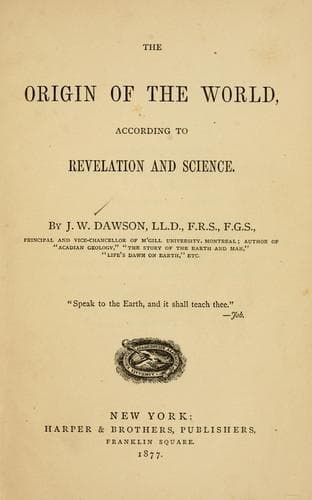
The Origin of the World According to Revelation and ScienceDawson, John William, Sir
Religion
The Origin of the World According to Revelation and Science
Dawson, John William, Sir
Bible and science; Religion and science
of only one member of the Carboniferous system, itself only a member
of the great Palaeozoic group, and we have made no allowance for the
abrasion from previous rocks and deposition of the immense mass of
sandy and muddy sediment in which the coals and forests are imbedded,
and which is vastly greater than the deltas of the largest modern
rivers.
Considerations of a physical rather than of a geological nature also
give us long periods for the probable existence of the earth, though
they serve to correct somewhat the extravagant estimates of some
theorists. Croll has based an interesting calculation on the amount of
erosion of the land by rivers. That of the Mississippi amounts to one
foot in 6000 years. That of the Ganges gives one foot in 2358 years,
the average being, say, one foot in 4179 years. Some smaller rivers
give a much shorter time; but the average of two great rivers, one
draining a very large area of the western and another of the eastern
hemisphere, and in very different climates and geographical
conditions, will probably be the most reliable datum. Croll, however,
prefers the Mississippi rate.[145] If we estimate the proportion of
land to water as 576 to 1390, this will give for the entire area of
the ocean a rate of deposition of one foot in 14,400 years. Now the
entire thickness of all the stratified rocks is estimated at 72,000
feet; and at this rate the enormous time of 1,036,800,000 years would
be necessary. But we have no right to assume that deposition has been
going on uniformly over the entire sea-bottom. On the contrary, the
greater part of it takes place within a belt of about one hundred
miles from the coasts, and the deposit of calcareous and other matters
over the remainder will scarcely make up for the portions of this belt
on which no deposit is taking place. This will give an area of deposit
of about 11,650,000 square miles, consequently only one twelfth of the
above time, or about 86,400,000 years, would be required. This can be
but a very rough calculation; but it has the merit of squaring very
nearly with the calculations derived from physical considerations,
more especially by Sir William Thomson, which limit the possible
existence of the earth's solid crust to one hundred millions of years.
Similar conclusions have also been deduced from what is known of the
physical constitution of the sun. Croll's own ingenious theory of
glacial periods produced by the varying eccentricity of the earth's
orbit, along with the precession of the equinoxes, would give,
according to him, about 80,000 years ago for the date of the Glacial
period, and for the beginning of the Tertiary period about 3,000,000
years ago.
Public-domain text, read in full here on John Shaqi.
Reviews
Reviews
No reviews yet
Be the first to share your thoughts on this work.
Elsewhere in the archive
Join the Discussion
Join the discussion
Sign in to leave a comment or review.
Sign InorCreate an account