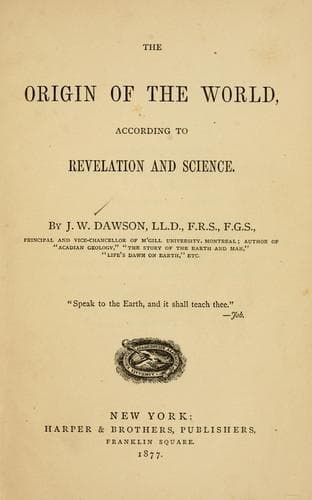
The Origin of the World According to Revelation and ScienceDawson, John William, Sir
Religion
The Origin of the World According to Revelation and Science
Dawson, John William, Sir
Bible and science; Religion and science
"Fourthly, these hypotheses are partial, inasmuch as they fail to
account for the vastly varied and correlated interdependencies of
natural things and forces, and for the unity of plan which pervades
the whole. These can be explained only by taking into the account
another element from without. Even when it professes to admit the
existence of a God, the evolutionist reasoning of our day contents
itself altogether with the physical or visible universe, and leaves
entirely out of sight the power of the unseen and spiritual, as if
this were something with which science has nothing to do, but which
belongs only to imagination or sentiment. So much has this been the
case, that when recently a few physicists and naturalists have turned
to this aspect of the case, they have seemed to be teaching new and
startling truths, though only reviving some of the oldest and most
permanent ideas of our race. From the dawn of human thought it has
been the conclusion alike of philosophers, theologians, and the
common-sense of mankind that the seen can be explained only by
reference to the unseen, and that any merely physical theory of the
world is necessarily partial. This, too, is the position of our sacred
Scriptures, and is broadly stated in their opening verse; and indeed
it lies alike at the basis of all true religion and all sound
philosophy, for it must necessarily be that 'the things that are seen
are temporal, the things that are unseen eternal.' With reference to
the primal aggregation of energy in the visible universe, with
reference to the introduction of life, with reference to the soul of
man, with reference to the heavenly gifts of genius and prophecy, with
reference to the introduction of the Saviour himself into the world,
and with reference to the spiritual gifts and graces of God's
people--all these spring not from sporadic acts of intervention, but
from the continuous action of God and the unseen world, and this we
must never forget is the true ideal of creation in Scripture and in
sound theology. Only in such exceptional and little influential
philosophies as that of Democritus, and in the speculations of a few
men carried off their balance by the brilliant physical discoveries of
our age, has this necessarily partial and imperfect view been adopted.
Never, indeed, was its imperfection more clear than in the light of
modern science.
Public-domain text, read in full here on John Shaqi.
Reviews
Reviews
No reviews yet
Be the first to share your thoughts on this work.
Elsewhere in the archive
Join the Discussion
Join the discussion
Sign in to leave a comment or review.
Sign InorCreate an account