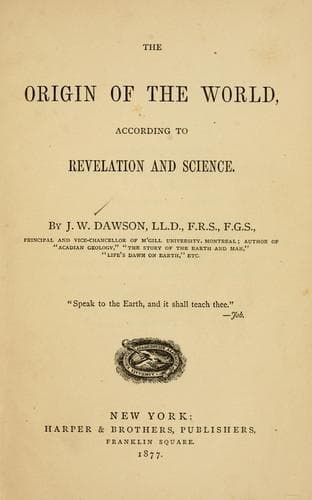
The Origin of the World According to Revelation and ScienceDawson, John William, Sir
Religion
The Origin of the World According to Revelation and Science
Dawson, John William, Sir
Bible and science; Religion and science
"It is here that natural science meets with theology, not as an
antagonist, but as a friend and ally in its time of greatest need; and
I must here record my belief that neither men of science nor
theologians have a right to separate what God in Holy Scripture has
joined together, or to build up a wall between nature and religion,
and write upon it 'no thoroughfare.' The science that does this must
be impotent to explain nature, and without hold on the higher
sentiments of man. The theology that does this must sink into mere
superstition.
"In conclusion, can we formulate a few of the general laws, or perhaps
I had better call them general conclusions, respecting life, in which
all palaeontologists may agree? Perhaps it is not possible to do this
at present satisfactorily, but the attempt may do no harm. We may,
then, I think, make the following affirmations:
"1. The existence of life and organization on the earth is not
eternal, nor even coeval with the beginning of the physical universe,
but may possibly date from Laurentian or immediately pre-Laurentian
times.
"2. The introduction of new species of animals and plants has been a
continuous process, not necessarily in the sense of derivation of one
species from another, but in the higher sense of the continued
operation of the cause or causes which introduced life at first. This,
as already stated, I take to be the true theological or Scriptural as
well as scientific idea of what we ordinarily and somewhat loosely
term creation.
"3. Though thus continuous, the process has not been uniform; but
periods of rapid production of species have alternated with others in
which many disappeared and few were introduced. This may have been an
effect of physical cycles reacting on the progress of life.
"4. Species, like individuals, have greater energy and vitality in
their younger stages, and rapidly assume all their varietal forms, and
extend themselves as widely as external circumstances will permit.
Like individuals also, they have their periods of old age and decay,
though the life of some species has been of enormous duration in
comparison with that of others; the difference appearing to be
connected with degrees of adaptation to different conditions of life.
"5. Many allied species, constituting groups of animals and plants,
have made their appearance at once in various parts of the earth, and
these groups have obeyed the same laws with the individual and the
species in culminating rapidly, and then slowly diminishing, though a
large group once introduced has rarely disappeared altogether.
"6. Groups of species, as genera and orders, do not usually begin with
their highest or lowest forms, but with intermediate and generalized
types, and they show a capacity for both elevation and degradation in
their subsequent history.
Public-domain text, read in full here on John Shaqi.
Reviews
Reviews
No reviews yet
Be the first to share your thoughts on this work.
Elsewhere in the archive
Join the Discussion
Join the discussion
Sign in to leave a comment or review.
Sign InorCreate an account