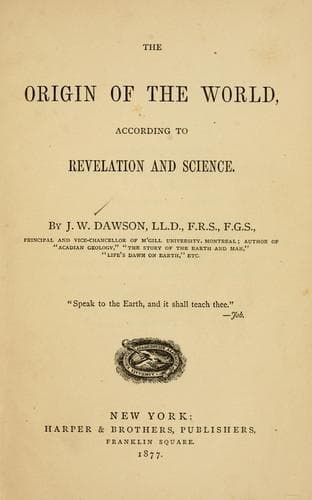
The Origin of the World According to Revelation and ScienceDawson, John William, Sir
Religion
The Origin of the World According to Revelation and Science
Dawson, John William, Sir
Bible and science; Religion and science
A question often asked, but not easily answered, with reference to the
creation of animals and plants, is--What was its precise method, and
to what extent is such intervention conceivable. This is, it is true,
not a properly scientific question, since science can not inform us of
the act of creation. Nor is it properly a theological one, since
revelation appeals to our faith in the facts, without giving us much
information as to the mode. It can, therefore, be answered only
conjecturally, except in so far as the law or plan of creation can be
inferred from what is known, either from science or revelation, as to
the history of life.
We may, in the first place, assume that law or plan must characterize
creation. The Scriptural idea of it is not reconcilable with the
supposition of a series of arbitrary acts any more than the scientific
idea. The nature of these laws, as disclosed by Palaeontology, has been
already considered in a preceding part of this Appendix. What we may
conjecture as to the nature of the creative act itself, from a
comparison of nature and revelation, may be summed up as follows:
1. If we reduce organized beings to their ultimate organisms--cells or
plastids--and with Spencer and Haeckel suppose these to be farther
divisible into still smaller particles or plastidules, each composed
of several complex particles of albumen or protoplasm, we may suppose
the primary act of creation to consist in the aggregation of molecules
of albuminous matter into such plastidules bearing the same relations,
as "manufactured articles," to the future cell that inorganic
molecules bear to crystals, and possessing within themselves the
potencies of organic forms. This is the nearest approach that we can
make to the primary creative act, and its scientific basis is merely
hypothetical, while revelation gives us no intimation as to any such
constitution of organized matter.
2. The formulae in Genesis, "Let the land produce," and "Let the waters
produce," imply some sort of mediate creation through the agency of
the land and the waters, but of what sort we have no means of knowing.
They include, however, the idea of the origin of the lower and humbler
forms of life from material pre-existing in inorganic nature, and also
the idea of the previous preparation of the land and the waters for
the sustenance of the creatures produced.
3. The expression in the case of man--"out of the dust"--would seem to
intimate that the human body was constituted of merely elementary
matter, without any previous preparation in organic forms. It may,
however, be intended merely to inform us that, while the spirit is in
the image of God, the bodily frame is "of the earth earthy," and in no
respect different in general nature from that of the inferior animals.
Public-domain text, read in full here on John Shaqi.
Reviews
Reviews
No reviews yet
Be the first to share your thoughts on this work.
Elsewhere in the archive
Join the Discussion
Join the discussion
Sign in to leave a comment or review.
Sign InorCreate an account