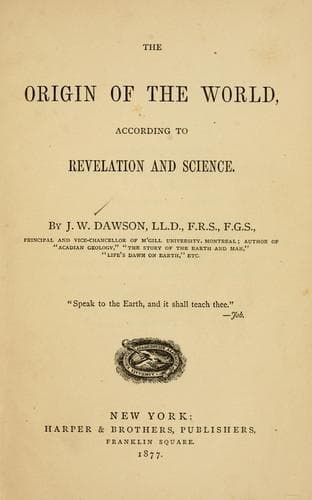
The Origin of the World According to Revelation and ScienceDawson, John William, Sir
Religion
The Origin of the World According to Revelation and Science
Dawson, John William, Sir
Bible and science; Religion and science
4. The Bible indicates some ways in which creatures may be modified or
changed into new species, or may give rise to new forms of life. The
human body is, we are told, capable of transformation into a new or
spiritual body, different in many important respects, and the future
general prevalence of this change is an article of religious faith.
The Bible represents the woman as produced from the man by a species
of fission, not known to us as a natural possibility, except in some
of the lower forms of life. The birth of the Saviour is represented as
having been by parthenogenesis, and if it had pleased God that Jesus
was to remain on earth as the progenitor of a new and higher type of
man to replace that now existing, this might be regarded as the
introduction of a new species. To what extent the Creator may have so
acted on the constitution of organized beings as to produce changes of
this kind we have no means of knowing; but if he have done so, we may
be sure that it has been in accordance with some definite plan or law.
5. We have a right to infer from Scripture that there must be some
creative law which provides for the introduction of species, _de
novo_, from unorganized matter, and which has been or is called into
action by conditions as yet altogether unknown to us, and as yet
inimitable, and therefore in some sense miraculous. Whether we shall
ever by scientific investigation discover the law of this kind of
divine intervention it is impossible to say. That all the theories of
spontaneous generation and derivation hitherto promulgated are but
wild guesses at it is but too evident.
6. Since in inorganic nature we meet with such ultimate facts as atoms
of different kinds and with different properties; and ether of
non-atomic constitution, all of which seem to be necessary to the
existence of the world as it is, we may expect in like manner to find
at the basis of organic structures and phenomena varied kinds of
ultimate organisms and forces, probably much more complicated than
those of inorganic nature. The broad simplicity of existing theories
of derivation and evolution is thus in itself a presumption against
their truth, except as very partial explanations.
7. We have no right to consider the species "after their kinds" of
revelation as coincident with the species recognized by science. Many
of these may be merely races, the production of which in the course of
time and in special circumstances may fall within the powers of
created species, and which may merely be the phases of such species in
time and place. Only the accumulation of vast additional stores of
facts can enable us to have any certain opinion on this point, and
till it is settled the doctrine of derivation must remain purely
hypothetical.
Public-domain text, read in full here on John Shaqi.
Reviews
Reviews
No reviews yet
Be the first to share your thoughts on this work.
Elsewhere in the archive
Join the Discussion
Join the discussion
Sign in to leave a comment or review.
Sign InorCreate an account