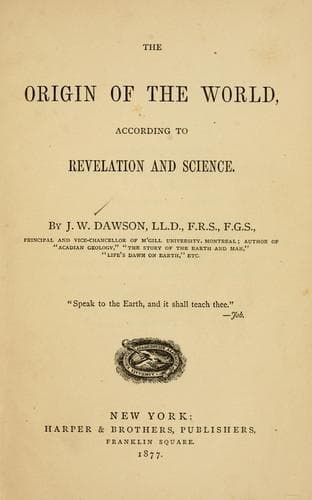
The Origin of the World According to Revelation and Science — John Shaqi
The Origin of the World According to Revelation and ScienceDawson, John William, Sir
Religion
The Origin of the World According to Revelation and Science
Dawson, John William, Sir
Bible and science; Religion and science
Every student of human nature is aware of the influence in favor of
the appreciation of natural beauty and sublimity which the Bible
impresses on those who are deeply imbued with its teaching; even where
that same teaching has induced what may be regarded as a puritanical
dislike of imitative art, at least in its religious aspects. On the
other hand, naturalists can not refuse to acknowledge the surpassing
majesty of the views of nature presented in the Bible. No one has
expressed this better than Humboldt: "It is characteristic of the
poetry of the Hebrews that, as a reflex of monotheism, it always
embraces the universe in its unity, comprising both terrestrial life
and the luminous realms of space; it dwells but rarely on the
individuality of phenomena, preferring the contemplation of great
masses. The Hebrew poet does not depict nature as a self-dependent
object, glorious in its individual beauty, but always as in relation
or subjection to a higher spiritual power. Nature is to him a work of
creation and order--the living expression of the omnipresence of the
Divinity in the visible world." In reference to the 104th Psalm, which
may be viewed as a poetical version of the narrative of creation in
Genesis, the same great writer remarks: "We are astonished to find in
a lyrical poem of such a limited compass, the whole universe--the
heavens and the earth--sketched with a few bold touches. The calm and
toilsome life of man, from the rising of the sun to the setting of the
same, when his daily work is done, is here contrasted with the moving
life of the elements of nature. This contrast and generalization in
the conception of the mutual action of natural phenomena, and the
retrospection of an omnipresent invisible Power, which can renew the
earth or crumble it to dust, constitute a solemn and exalted rather
than a gentle form of poetic creation."[8]
Public-domain text, read in full here on John Shaqi.
Reviews
Reviews
No reviews yet
Be the first to share your thoughts on this work.
Join the Discussion
Join the discussion
Sign in to leave a comment or review.
Sign InorCreate an account