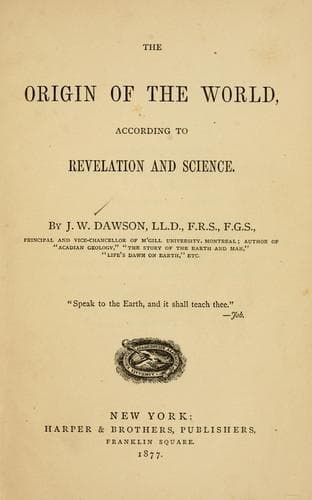
The Origin of the World According to Revelation and ScienceDawson, John William, Sir
Religion
The Origin of the World According to Revelation and Science
Dawson, John William, Sir
Bible and science; Religion and science
I have stated the above propositions to show that the Bible affords a
rational and connected theory of the origin of the false religions of
antiquity; and to suggest as inquiries in relation to every form of
mythology--how much of it is primitive monotheism, how much
cherub-worship, how much hero-worship, how much ancestor-worship, how
much distorted cosmogony, how much pure idealism and superstition,
since all these are usually present. I may be allowed further to
remind the reader how much evidence we have, even in modern times, of
the strong tendency of the human mind to fall into one or another of
these forms of idolatry; and to ask him to reflect that really the
only effectual conservative element is that of revelation. How strong
an argument is this for the necessity to man of an inspired rule of
religious faith.
[The above note was in substance contained in the Appendix to
"Archaia" in 1860, and its correctness has, I think, been confirmed by
subsequent discoveries.]
K.--ASSYRIAN AND EGYPTIAN TEXTS.
Progress is continually being made in the decipherment and publication
of these, and new facts are coming to light in consequence as to the
religions of the early postdiluvian period.
According to the late George Smith and to Mr. Sayce, in their
contributions to Bagster's "Records of the Past," the earliest
monumental history of Babylonia reveals two races, the Akkadian or
Urdu, a Turanian race, with an agglutinate language of the Finnish or
Tartar type, and the Sumir or Keen-gi, believed to be Shemitic. The
race of Akkad seems to have invented the cuneiform writing at a very
early period, and it no doubt represents the primitive Cushites of the
Bible, to whom is attributed the empire of Nimrod, whose first cities
were Babel and Erech and Akkad and Calneh. Very ancient inscriptions
of this early Chaldean or Cushite race exist, probably earlier than
the time of Abraham. That of king Urukh, who is called "a very ancient
king," on an inscription of Nabonadius, 555 B.C., represents himself
as building temples to several gods and goddesses, so that in his time
there was already a developed polytheism, unless, indeed, he was
himself the inventor or introducer of much of it. Yet one can gather
from the probably contemporary Creation and Deluge tablets translated
by Mr. Smith, that a Supreme God was still recognized, and that the
subordinate deities, though their worship was probably gaining in
importance, were still only local and created beings. Yet it was
undoubtedly from this embryo idolatry that Abraham dissented, and was
thus led to leave his native land.
In like manner, in the early Egyptian Hymn to Amen Ra, translated by
Mr. Goodwin, though we have the gods mentioned, they are inferior
beings, and not higher in position than the angels of the Old
Testament, while Ra himself is "Lord of Eternity, Maker Everlasting,"
and is praised as
Public-domain text, read in full here on John Shaqi.
Reviews
Reviews
No reviews yet
Be the first to share your thoughts on this work.
Elsewhere in the archive
Join the Discussion
Join the discussion
Sign in to leave a comment or review.
Sign InorCreate an account