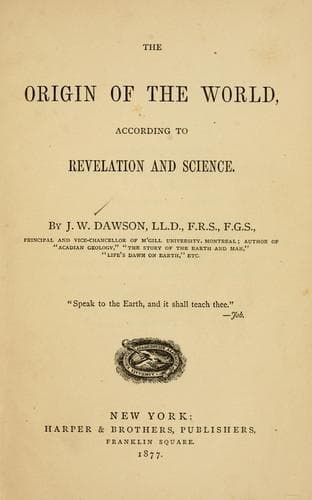
The Origin of the World According to Revelation and ScienceDawson, John William, Sir
Religion
The Origin of the World According to Revelation and Science
Dawson, John William, Sir
Bible and science; Religion and science
5. In all rude and imaginative nations, which have lost the distinct
idea of the one God, the Creator, nature becomes more or less a
source of superstitions. Its grand and more rare phenomena of
volcanoes, earthquakes, thunder-storms, eclipses, become supernatural
portents; and as the idea of power associates itself with them, they
are personified as actual agents and become gods. In like manner, the
more constant and useful objects and processes of nature become
personified as beneficent deities. This may be, to a great extent, the
character of the Aryan theology; but, except where all ideas of
primitive religion and traditions of early history have been lost, it
can not be the whole of the religion of any people. The Bible
negatively recognizes this source of idolatry, in so constantly
referring all natural phenomena to the divine decree. In connection
with this, it is worthy of remark that rude man tends to venerate the
new animal forms of strange lands. Something of this kind has probably
led some of the American Indians to give a sort of divine honor to the
bear. It was in Egypt that man first became familiar with the strange
and gigantic fauna of Africa, whose effect on his mind in primitive
times we may gather from the book of Job. In Egypt, consequently,
there must have been a strong natural tendency to the adoration of
animals.
The above origins of idolatry and mythology, as stated or implied in
the Bible, of course assume that the Semitic monotheistic religion is
the primitive one. The first deviations from it probably originated in
the family of Ham. A city of the Rephaim of Bashan was in the days of
Abraham named after Ashtoreth Karnaim--the two-horned Astarte, a
female divinity and prototype of Diana, and perhaps an historic
personage, in whom both the moon and the domestic ox were rendered
objects of worship. This is the earliest Bible notice of
idolatry.[160] In Egypt a mythology of complex diversity existed at
least as far back. We must remember, however, that Egypt is Cush as
well as Mizraim, and its idolatry is probably to be traced, in the
first instance, to the Nimrodic empire, from which, as from a common
centre, certain new and irreligious ideas seem to have been propagated
among all the branches of the human family. It is quite probable that
the correspondences between Egyptian, Greek, and Hindoo myths go back
as far as to the time when the first despotism was erected on the
plain of Shinar, and when able but ungodly men set themselves to erect
new political and social institutions on the ruins of all that their
fathers had held sacred. In addition to this, the mythology and
language of the Aryans alike bear the impress of the innovating and
restless spirit of the sons of Japhet.
Public-domain text, read in full here on John Shaqi.
Reviews
Reviews
No reviews yet
Be the first to share your thoughts on this work.
Elsewhere in the archive
Join the Discussion
Join the discussion
Sign in to leave a comment or review.
Sign InorCreate an account