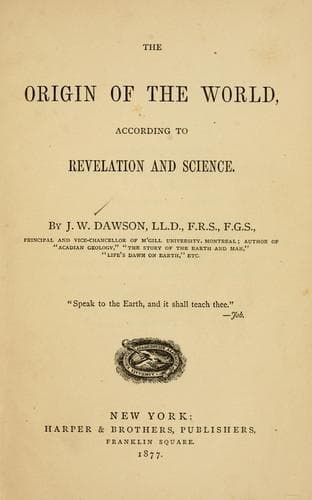
The Origin of the World According to Revelation and ScienceDawson, John William, Sir
Religion
The Origin of the World According to Revelation and Science
Dawson, John William, Sir
Bible and science; Religion and science
We can determine species only by the comparison of individuals. If all
these agree in all their characters except those appertaining to sex,
age, and other conditions of the individual merely, we say that they
belong to the same species. If all species were invariable to this
extent, there could be no practical difficulty, except that of
obtaining specimens for comparison. But in the case of very many
species there are minor differences, not sufficient to establish
specific diversity, but to suggest its possibility; and in such cases
there is often great liability to error. In cases of this kind we have
principally two criteria: first, the nature and amount of the
differences; secondly, their shading gradually into each other, or the
contrary. Under the first of these we inquire--Are they no greater in
amount than those which may be observed in individuals of the same
parentage? Are they no greater than those which occur in other species
of similar structure or habits? Do they occur in points known in
other species to be readily variable, or in points that usually remain
unchanged? Are none of them constant in the one supposed species, and
constantly absent in the other? Under the second we ask--Are the
individuals presenting these differences connected together by others
showing a series of gradations uniting the extremes by minute degrees
of difference? If we can answer these questions--or such of them as we
have the means of answering--in the affirmative, we have no hesitation
in referring all to the same species. If obliged to answer all or many
in the negative, we must at least hesitate in the identification; and
if the material is abundant, and the distinguishing characters clear
and well defined, we conclude that there is a specific difference.
Species determined in this way must possess certain general properties
in common:
1. Their individuals must fall within a certain range of uniform
characters, wider or narrower in the case of different species.
2. The intervals between species must be distinctly marked, and not
slurred over by intermediate gradations.
3. The specific characters must be invariably transmitted from
generation to generation, so that they remain equally distinct in
their limits if traced backward or forward in time, in so far as our
observation may extend.
4. Within the limits of the species there is more or less liability to
variation; and this, though perhaps developed by external
circumstances, is really inherent in the species, and must necessarily
form a part of its proper description.
Public-domain text, read in full here on John Shaqi.
Reviews
Reviews
No reviews yet
Be the first to share your thoughts on this work.
Elsewhere in the archive
Join the Discussion
Join the discussion
Sign in to leave a comment or review.
Sign InorCreate an account