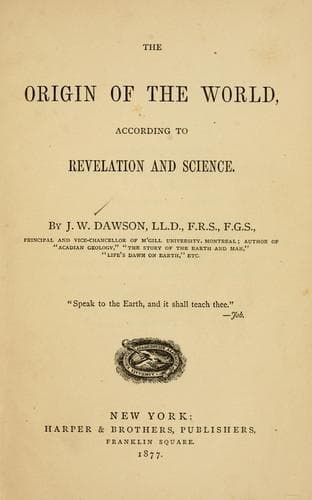
The Origin of the World According to Revelation and ScienceDawson, John William, Sir
Religion
The Origin of the World According to Revelation and Science
Dawson, John William, Sir
Bible and science; Religion and science
5. There is also a physiological distinction between species, namely,
that the individuals are sterile with one another, whereas this does
not apply to varieties; and though Darwin has labored to break down
this distinction by insisting on rare exceptional cases, and
suggesting many supposed ways by which varieties of the same species
might possibly attain to this kind of distinctness, the difference
still remains as a fact in nature; though one not readily available in
practically distinguishing species.
These general properties of species will, I think, be admitted by all
naturalists as based on nature, and absolutely necessary to the
existence of natural history as a science, independently of any
hypotheses as to the possible changes of specific forms in the lapse
of time. I now proceed to give a similar summary of the laws of the
varieties which may exist--always be it observed, within the limits of
the species.
1. The limits of variation are very different in different species.
There are many in which no well-marked variations have been observed.
There are others in which the variations are so marked that they have
been divided, even by skilful naturalists, into distinct species or
even genera. I do not here refer to differences of age and sex. These
in many animals are so great that nothing but actual knowledge of the
relation that subsists would prevent the individuals from being
entirely separated from one another. I refer merely to the varieties
that exist in adults of the same sex, including, however, those that
depend on arrest of development, and thus make the adult of one
variety resemble in some respects the young of another; as, for
instance, in the hornless oxen, and beardless individuals among men.
If we inquire as to the causes on which the greater or less
disposition to vary depends, we must, in the first place, confess our
ignorance, by saying that it appears to be in a great measure
constitutional, or dependent on minute and as yet not distinctly
appreciable structural, physiological, and psychical characters.
Darwin states that Pallas long ago suggested, from the known facts
that the seeds of hybrid plants and grafted trees are very variable,
the theory that mixture of breeds tends to produce variability; but
Darwin does not seem to attach much importance to this, and admits our
inability to explain the origin of these differences.[161] We know,
however, certain properties of species that are always or usually
connected with great liability to variation. The principal of these
are the following: 1. The liability to vary is, in many cases, not
merely a specific peculiarity; it is often general in the members of a
genus or family. Thus the cats, as a family, are little prone to vary;
the wolves and foxes very much so. 2. Species that are very widely
distributed over the earth's surface are usually very variable. In
this case the capacity to vary probably adapts the creature to a great
Public-domain text, read in full here on John Shaqi.
Reviews
Reviews
No reviews yet
Be the first to share your thoughts on this work.
Elsewhere in the archive
Join the Discussion
Join the discussion
Sign in to leave a comment or review.
Sign InorCreate an account