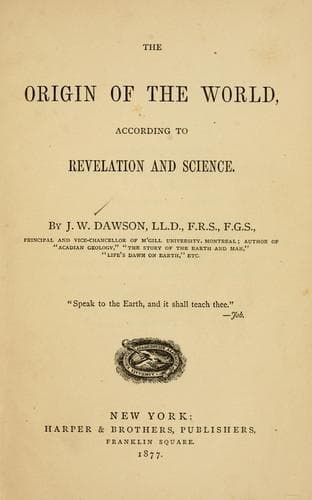
The Origin of the World According to Revelation and ScienceDawson, John William, Sir
Religion
The Origin of the World According to Revelation and Science
Dawson, John William, Sir
Bible and science; Religion and science
Dr. Pickering, of the U. S. Exploring Expedition[166]--who does not,
however, commit himself to any specific distinctions--has arranged the
various races of men on the very simple and obvious ground of color.
He obtains in this way four races--the White, the Brown, the
Blackish-brown, the Black. The distinction is easy; but it divides
races historically, philologically, and structurally alike; and unites
those which, on other grounds, would be separated. The white race
includes the Hamite Abyssinian, the Semitic Arabian, the Japhetic
Greek. The Ethiopian or Berber is separated from the cognate
Abyssinian, and the dark Hindoo from the paler races speaking like him
tongues allied to the Sanscrit. The Papuan, on the other hand, takes
his place with the Hindoo; while the allied Australian must be content
to rank with the Negro; and the Hottentot is promoted to a place
beside the Malay. It is unnecessary to pursue any farther the
arrangement of this painstaking and conscientious inquirer. It
conclusively demonstrates that the color of the varieties of the human
race must be arbitrary and accidental, and altogether independent of
unity or diversity of origin.
Some use has been made, by the advocates of diversity of species, of
the quality of the hair in the different races. That of the Negro is
said to be flat in its cross section--in this respect approaching to
wool; that of the European is oval; and that of the Mongolian and
American round.[167] The subject has as yet been very imperfectly
investigated; but its indications point to no greater variety than
that which occurs in many domesticated animals--as, for instance, the
hog and sheep. Nay, Dr. Carpenter states[168]--and the writer has
satisfied himself of the fact by his own observation--that it does not
exceed the differences in the hair from different parts of the body of
the same individual. The human hair, like that of mammals in general,
consists of three tissues: an outer cortical layer, marked by
transverse striae, having in man the aspect of delicate lines, but in
many other animals assuming the character of distinct joints or
prominent serrations; a layer of elongated, fibrous cells, to which
the hair owes most of its tenacity; and an inner cylinder of rounded
cells. In the proportionate development of these several parts, in the
quantity of coloring matter present, and in the transverse section,
the human hair differs very considerably in different parts of the
body. It also differs very markedly in individuals of different
complexions. Similar but not greater differences obtain in the hair of
the scalp in different races; but the flatness of the Negro's hair
connects itself inseparably with the oval of the hair of the ordinary
European, and this with the round observed in some other races. It
generally holds that curled and frizzled hair is flatter than that
which is lank and straight; but this is not constant, for I have found
Public-domain text, read in full here on John Shaqi.
Reviews
Reviews
No reviews yet
Be the first to share your thoughts on this work.
Elsewhere in the archive
Join the Discussion
Join the discussion
Sign in to leave a comment or review.
Sign InorCreate an account