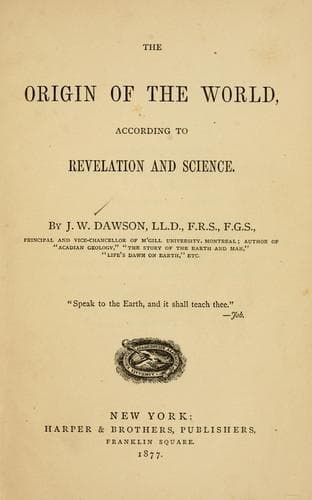
The Origin of the World According to Revelation and ScienceDawson, John William, Sir
Religion
The Origin of the World According to Revelation and Science
Dawson, John William, Sir
Bible and science; Religion and science
that the waved or frizzled hair of the New Hebrideans, intermediate
apparently between the Polynesians and Papuans, is nearly circular in
outline, and differs from European hair mainly in the greater
development of the fibrous structure and the intensity of the color.
Large series of comparisons are required; but those already made point
to variation rather than specific difference. Some facts also appear
to indicate very marked differences as occurring in the same race from
constant exposure or habitual covering; and also the occasional
appearance of the most abnormal forms, without apparent cause, in
individuals. The differences depending on greater or less abundance or
vigor of growth of the hair are obviously altogether trivial, when
compared with such examples as the hairless dogs of Chili and hairless
cattle of Brazil, or even with the differences in this respect
observed in individuals of the same race of men.
Confessedly the most important differences of the races of men are
those of the skeleton, in all parts of which variations of proportion
occur, and are of course more or less communicated to the muscular
investments. Of these, as they exist in the pelvis, limbs, etc., I
need say nothing; for, manifest though they are, they all fall far
within the limits of variation in familiar domestic animals, and also
of hereditary malformation or defect of development occurring in the
European nations, and only requiring isolation for its perpetuation as
a race. The differences in the skull merit more attention, for it is
in this and in its enclosed brain that man most markedly differs from
the lower animals, as well as race from race. It is in the form rather
than in the mere dimensions of the skull that we should look for
specific differences; and here, adopting the vertical method of
Blumenbach as the most characteristic and valuable, we find a greater
or less antero-posterior diameter--a greater or less development of
the jaws and bones of the face. The skull of the normal European, or
Caucasian of Cuvier, is round oval; and the jaws and cheek-bones
project little beyond its anterior margin, when viewed from above. The
skull of the Mongolian of Cuvier is nearly round, and the cheek-bones
and jaws project much more strongly in front and at the sides. The
Negro skull is lengthened from back to front; the jaws project
strongly, or are prognathous; but the cheek-bones are little
prominent. For the extremes of these varieties, Retzius proposed the
names of brachy-kephalic or short-headed, and dolicho-kephalic or
long-headed, which have come into general use. The differences
indicated by these terms are of great interest, as distinctive marks
of many of the unmixed races of men; but, when pushed to extremes,
lead to very incorrect generalizations--as Professor D. Wilson has
well shown in his paper on the supposed uniformity of type in the
American races--a doctrine which he fully refutes by showing that
Public-domain text, read in full here on John Shaqi.
Reviews
Reviews
No reviews yet
Be the first to share your thoughts on this work.
Elsewhere in the archive
Join the Discussion
Join the discussion
Sign in to leave a comment or review.
Sign InorCreate an account